Daphne Leong  1
1
How to cite
How to cite
Abstract
Abstract
In relating dance and music, choreographer Salva Sanchis aims to create “an opening for the audience to read something, to place their experience.” This chapter demonstrates how such openings are made in Sanchis and Anne Teresa De Keersmaeker’s 2017 choreography to John Coltrane’s A Love Supreme. In the first movement (“Acknowledgement”), the dance embodies, simplifies, and opens out the processes of the music, answering improvisation with improvisation. In the last movement (“Psalm”), the dance sculpts sonic unity and melodic drama, fleshing out fully improvised music with fully choreographed dance. The silent Prelude inverts the relationship of music and dance, of choreographed and improvised, of solo and ensemble; it “opens” the space for what is to follow.
Winner of the French dance press’s Prix de la critique for best performers, Salva Sanchis and Anne Teresa De Keersmaeker’s 2017 choreography to John Coltrane’s A Love Supreme brings dance composition and improvisation together in a unique response to the iconic album.2 Sanchis told me: “My objective is always to add some sense of dimension—to create a space in which there is the opening for the audience to read something, to place their experience.”3 This image—that of an opening—differs from common ways of describing relations between music and dance. Rather than parallelism and counterpoint, complementarity and interaction, composite form and mutual implication, Sanchis’s goal explicitly involves the audience, in an invitation to interpret.4
I find the metaphor of an opening suggestive, and will explore how composed and improvised processes—or, more broadly, the “known” and “unknown”5—carve open such a space in A Love Supreme. In this space, words, music, and dance play: words turn into music and music into words, dancers into musicians and musicians into dancers.
Each dancer embodies one member of John Coltrane’s quartet (figure 1): Thomas Vantuycom is John Coltrane’s saxophone (and voice); Bilal El Had, McCoy Tyner’s piano; Jason Respilieux, Jimmy Garrison’s bass; and José Paulo dos Santos, Elvin Jones’s drums.6 Each dancer dances only when his musician plays; and each—for the most part—improvises when his musician does. The fourth movement, as we shall see, shakes up the relationship among the four dancer-musicians.
Coltrane’s Love Supreme is a four-movement suite, half an hour in duration. Of the four movements, the first (“Acknowledgement”) and fourth (“Psalm”) are musically the most open-ended.7 They also exemplify opposite choreographic strategies. My discussion therefore focuses on the first and fourth movements; it also touches upon the silent danced prelude to the work.
Notational Conventions, Terms, and Abbreviations
-
Pitches in register are labeled following the Acoustical Society of America: middle C = C4.
-
{ } represent unordered sets.
-
Standard row form labels are used: P for the prime row form, and R for its retrograde. Subscripts indicate order numbers; for example, P5-8 indicates elements 5-8 of row P.
-
For the discussion of “Psalm,” scale degrees for C melodic minor are indicated by ordinary numbers for the octave C4-B4 (1-7), italics for the octave above (1-7), and underlines for the octave below (1–7). B♮ is scale degree 7, while B♭ is ♭7. Recitation tones are indicated by the suffix r.
-
I will occasionally refer to the piano / bass / drums (El Had / Respilieux / dos Santos) as the “rhythm section” (per common jazz parlance).
-
Videos: This study relies heavily upon video of a full performance of A Love Supreme. The video is not publicly available, and excerpts of it cannot be reproduced here due to copyright restrictions. References to such video excerpts are crossed out in the text; where available I have substituted published photographs supplied by De Keersmaeker’s dance company Rosas.8
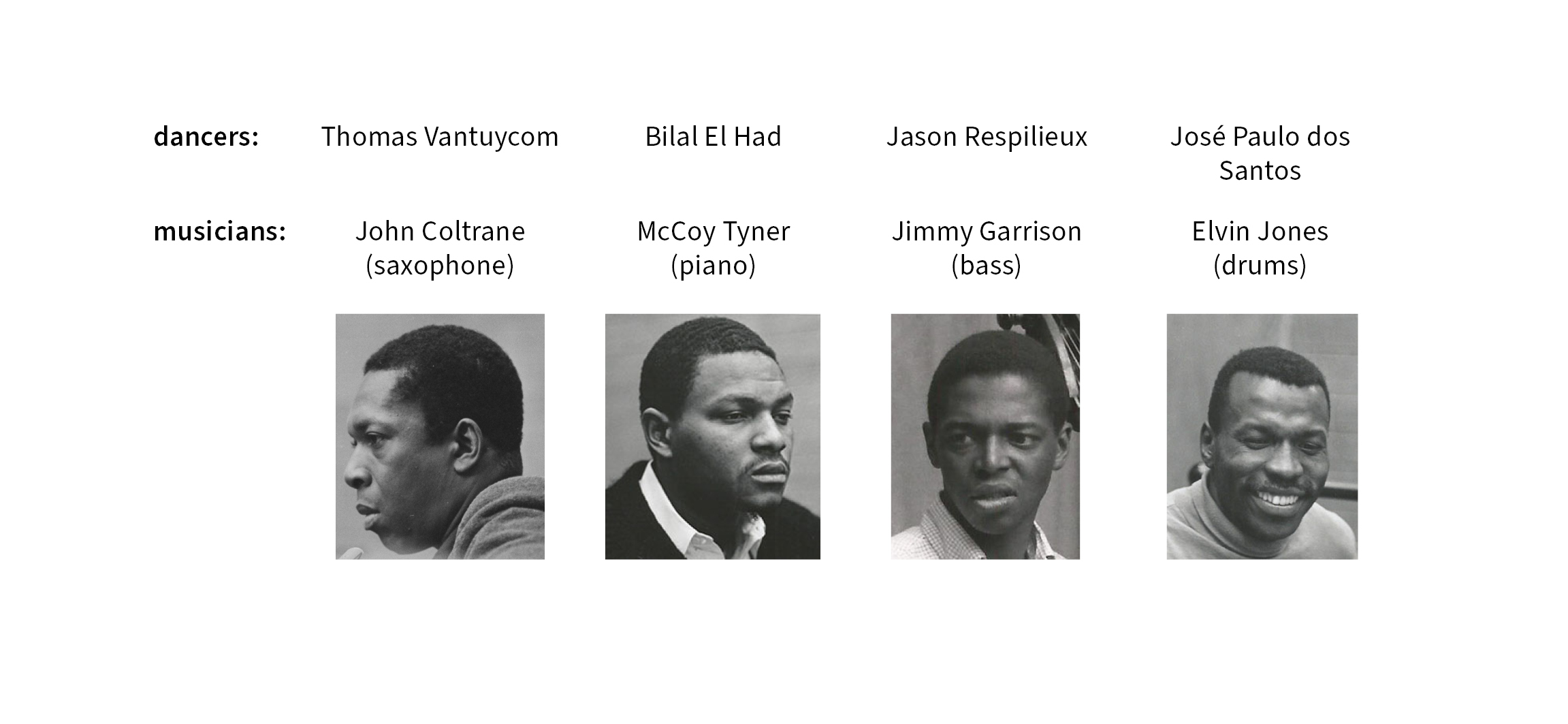
Figure 1: The dancers / musicians.9
I. “Acknowledgement”
The movement proper begins with the solo bass ostinato shown in music example 1.10 Underlying the entire movement, this ostinato serves as rhythmic pulse, bassline, and melodic motive combined.11 As is clear when comparing studio and live recordings, it is one of the movement’s few preconceived elements.12
The ostinato pairs <short-long, short-long> with metric <off-on, on-off> and articulative, dynamic, and pitch stress on the final “long,” to express a circular energy; the movement’s opening dance gesture (video 1) beautifully mirrors those parallel, flipping, and circular aspects. It also highlights the hands, a particular focus that we shall see throughout the choreography.
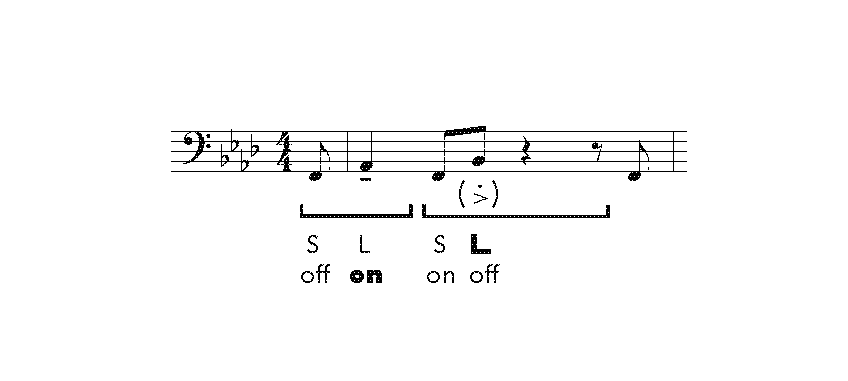
Music example 1: “Acknowledgement”: bass ostinato. © Daphne Leong
Video 1: “Acknowledgement”: opening hand gesture. Click to view (1:25–1:29): https://youtu.be/Dog1egx5OTU?feature=shared&t=8513
Both ostinato and opening dance gesture point forward to the climax of the movement: a revelation of the ostinato as the words “a love supreme.” Just preceding that moment, Coltrane’s saxophone takes over the bass ostinato and repeats it, for a total of thirty-six successive statements. I call this series of statements the “ostinato chain.” Figure 2 charts the beginning pitches of the statements; they cover the entire chromatic pitch range from C3 to E♭4 (saving E♭3 for the transition to the second movement). They begin on F3 (F is the movement’s centric pitch class) and conclude, after rising through a scale D3-E3-F♯3-G3-A♭3 (F♯ completes the pitch-class aggregate), again on F3 (stated eight times).14
At this point Coltrane reveals the origin of the ostinato; he chants “a love supreme” on the F3 ostinato motive sixteen times, then moves down to E♭3 (four times) to transition to the second movement.15 In the movement, then, the ostinato travels a journey of revelation: it opens as a bass motive, pervades as bassline and ground for improvisation throughout, intensifies its presence in the ostinato chain, and finally takes its essential form as the mantra “a love supreme” at the end of the movement.
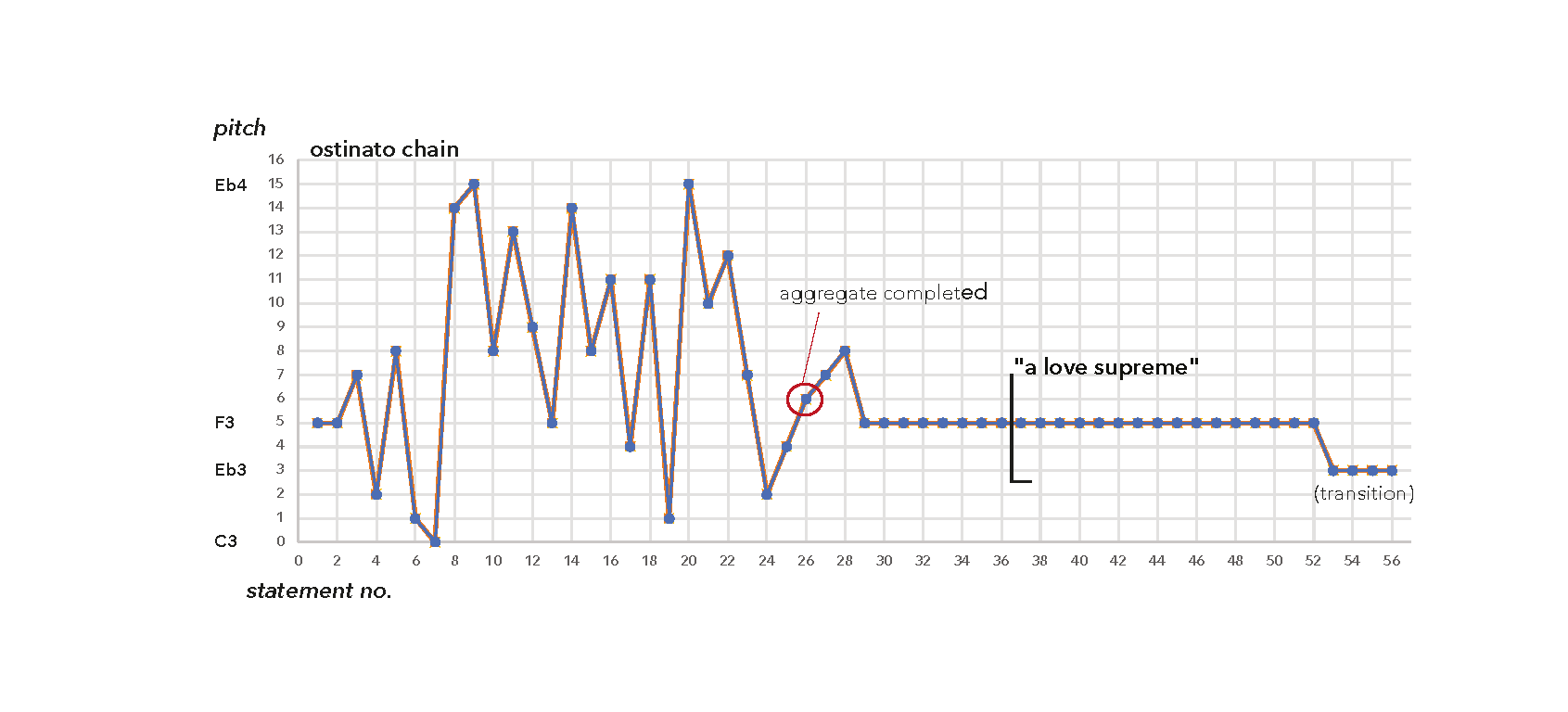
Figure 2: “Acknowledgement”: ostinato chain and chant. © Daphne Leong;
Click to listen (4:54–6:42): https://youtu.be/vMCHDC2Lurk?feature=shared&t=294
The dance follows a similar journey. A dance phrase (video 2), corresponding to the twenty chanted statements of “a love supreme,” serves as the source material for the entire movement.16 Sanchis describes the phrase as developing aspects of the bass ostinato and the opening dance cell. Like the ostinato and the cell, the phrase is repetitive without literal repetition. It carves its way by moving forward, reversing direction, and then reinitiating forward movement. It circles in space, twirling and turning. At times it compresses downward and then expands upward. The hands form a focus throughout, delineating space, rhythm, and dynamics.17
Creating such a phrase, says Sanchis, is “an excruciatingly slow process,” “almost like a sculptor, but in motion.”18 The phrase must be well-defined so that the improvisation can be strong:
The fact that A Love Supreme appears to be improvised is not because the written material [the dance phrase] looks open and improvised. In fact, it’s the other way around: the set material is so precise, as precise as possible, that it forces the improviser to then be equally precise. One could say that the phrase relates to the improvised transformations like the theme of a fugue relates to its development. One can’t just deploy any theme when drafting a fugue. There are certain qualities both in music and in movement that can make such a development more interesting for the performers and for the audience because it offers direction. I want to improvise in such a way that you believe that everything that I do is all I could have done. And that I did exactly what I intended. I don’t want you to see that I am trying, that I am looking for what exactly to do at that moment. I want my improvisation to look as clear and precise—as “determined,” if you will—as possible.19

Figure 3: Basic dance phrase: cell 15 (from left to right: Bilal El Had, Jason Respilieux, Thomas Vantuycom, José Paulo dos Santos). Photograph by Anne Van Aerschot. © 2019 by Rosas
The phrase underpins the movement in a clear-cut way. Video 3 shows the source version of the phrase (that setting the chanting of “a love supreme”) again. I number the cells of the dance phrase from 0 to 23: each cell matches one measure and one chanted “a love supreme.” Figure 3 shows cell 15. (Cell 24 has a special function, which we shall discuss later.) Since the chanting completes after twenty measures, the final four measures of the dance phrase form a codetta (with gestures that are less marked and more relaxed). I label the series of 24 cells “P,” like a musical row.20
Jason Respilieux (the bass) has the most straightforward as well as foundational role. Figure 4 shows how P appears in his dancing in the movement. Figure 4g, which sets “a love supreme,” is the source phrase. (Dance cell numbers appear below each row.) Figure 4f shows the ostinato chain, set by the retrograde of the basic dance phrase, labeled R. Since the ostinato chain occupies thirty-six measures, the basic dance phrase is expanded internally by two measures, and then augmented with a four-measure transition (shown in dark grey/blue) in which the dancers face the back of the stage, a two-measure turn to face forward (shown in an open box), and four additional measures (labeled 02H) that preface the basic dance phrase to follow.21 Video 4 shows the passage represented by figure 4f. (The phrase is danced by the “rhythm section,” behind Vantuycom. Note that, in the retrograde phrase, the gestures themselves—and not only their order—are reversed.)
As shown in figure 4a, the movement proper begins with the P dance phrase. Its opening is extended: cell 0 repeats for eight measures, shown as 01H (with one hand) and 02H (with both hands), followed by two measures using cells from the movement’s end (shown in dark grey/blue); cells 1 through 23 then complete the phrase. The phrase can be seen in Respilieux’s dancing in video 5 (part of the phrase is off camera).22
Figure 4 as a whole shows that Respilieux’s dancing in the movement proceeds straightforwardly through alternating P and R rows, except at figures 4d and 4e, where the rows involve only cells 10-23 (at first in R, and then in P). Cell 24 (not shown in figure 4) acts as a flexible hinge between P and R row forms.23 (Figure 5 shows dos Santos and Respilieux dancing cell 24 behind Vantuycom and El Had.)
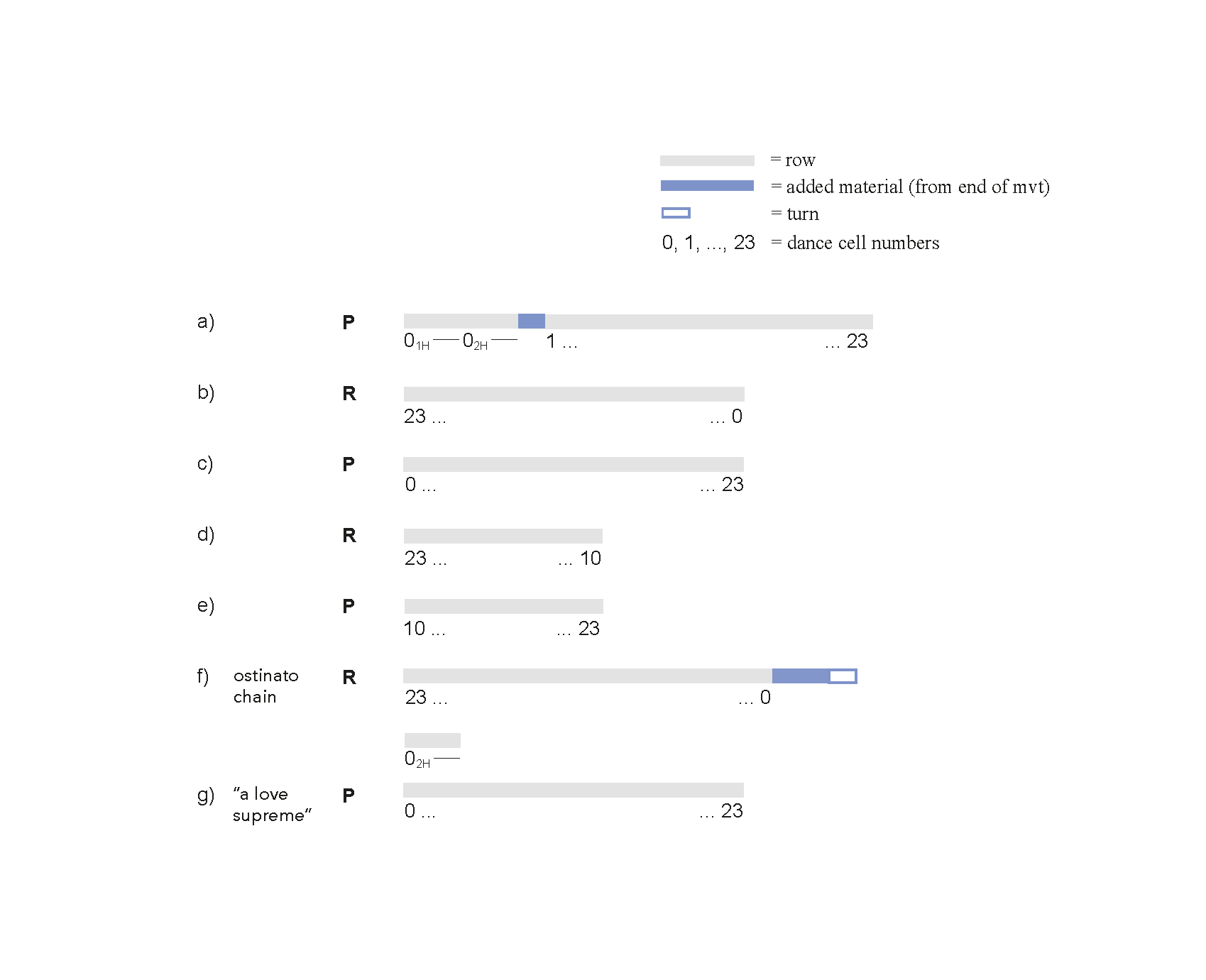
Figure 4: “Acknowledgement”: Respilieux’s use of the basic dance phrase.
© Daphne Leong

Figure 5: Dos Santos and Respilieux dancing cell 24 behind Vantuycom and El Had. Photograph by Anne Van Aerschot. © 2019 by Rosas
The dancers elaborate upon this choreographic substrate by taking on distinct roles, movement characteristics, and degrees of freedom. All of the dancers draw from the basic dance phrase. Respilieux, as the bass, has the most set role: he must complete the basic phrase by the end of each section, moving through its materials sequentially. Dos Santos, as the drums, also traverses the phrase. He remains linked to the bass, moving ahead or behind him in the sequence of movements, within a constrained range—and this is true spatially as well. Dos Santos can play with attack and acceleration. El Had, the piano, also works slightly behind and ahead of the others, but in a more staccato way, moving from pose to pose—performing the piano’s “comping” function.24 He bridges the space between the drums and bass and the saxophone solo; he dances on the line between the bass and the saxophone. Vantuycom, as the saxophone, is free to improvise, drawing from the phrase as he wishes.25 The dance phrase, like the bass ostinato, therefore, plays multiple roles, in both foreground and background;26 it provides the material for the dancers’ enactment of characteristic relations among jazz rhythm section and soloist.
Vantuycom was instructed to “dance as if you are the saxophone.” Thus, though his dance parameters are much freer than those of the others, he is paradoxically “much more tied to and constrained by the music. […] Remember that Thomas isn’t dancing to live improvised music, which would continuously surprise him.” Rather, “we treat this improvised recording as a type of score […]. It isn’t written down in notes, but, much like a score, it’s a kind of residue, in the very literal sense a record, the registration of a musical performance.”27
Vantuycom listened to the recording repeatedly: his improvisatory freedom was fueled by his ability to anticipate exactly what would happen musically and when. In rehearsal all four dancers sang the music as they danced (switching their singing from instrument to instrument).28
Dancing to a fixed recording also afforded a clear choreographic plan. Figure 6 shows the entry of the instruments and their associated dancers one by one at the beginning of the movement (figure 6a) and their exits in reverse order at the end (figure 6b). Horizontal lines indicate unison dancing. As they enter, the rhythm section dances in unison—until the entrance of the saxophone. Thus, in the first P row, cell 0 through the downbeat of cell 7 (the saxophone entry) are danced in unison. Thereafter, dancers undertake differentiated roles, as described earlier. (Respilieux, as the bass, continues with the P row gestures.) Video 5 shows this opening and the move from unison to differentiated dancing.29
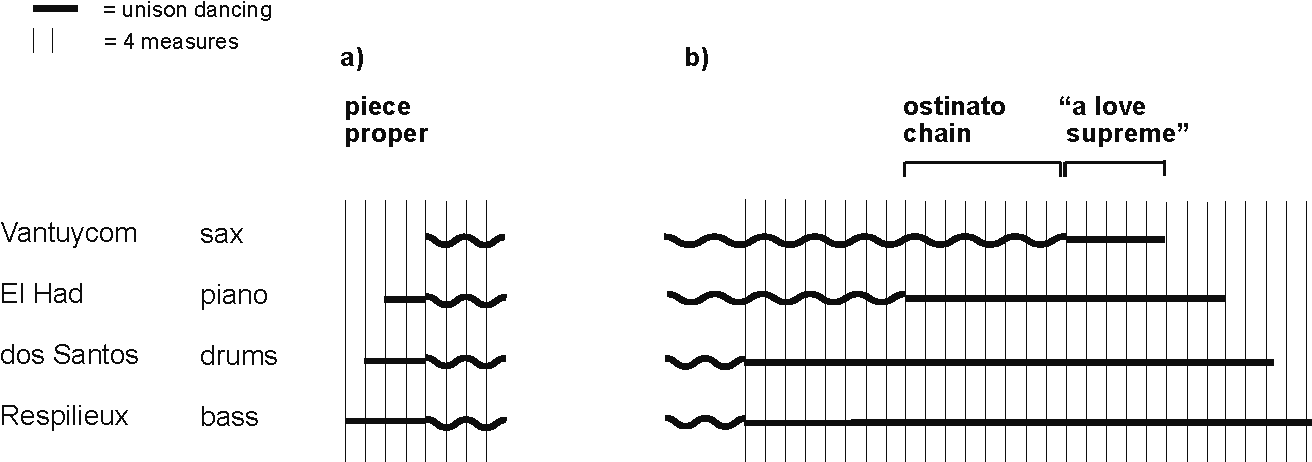
Figure 6: “Acknowledgement”: unison dancing (beginning and end of movement). © Daphne Leong
Towards the end of the movement, unison dancing reappears additively: first, as shown in figure 6b, between Respilieux and dos Santos (bass and drums), then adding El Had (completing the rhythm section) and finally Vantuycom (the entire quartet). The rhythm section unison highlights the ostinato chain, and the quartet unison punctuates the arrival of the chanted “love supreme.”30 The complete basic dance phrase (in its source, P, form) comes to the fore only here. Thus unison dancing frames the movement and creates a dramatic sense of emergence for the chanting of “a love supreme.”
Aspects of the composition of this opening movement are reminiscent of principles found in other De Keersmaeker choreographies. Video 6 shows the gesture of the hands in “Come Out,”31 similar to Love Supreme’s opening gesture in its circularity and fluid motion. The temporal and qualitative variations on Love Supreme’s repeated dance cells, if different in quality from those of De Keersmaeker’s Reich choreographies, nevertheless remind one of them in their constructive principle and in the choreographer’s use of pulling apart and coming together.32 One finds here both parallelism and counterpoint, sameness and difference—and space.
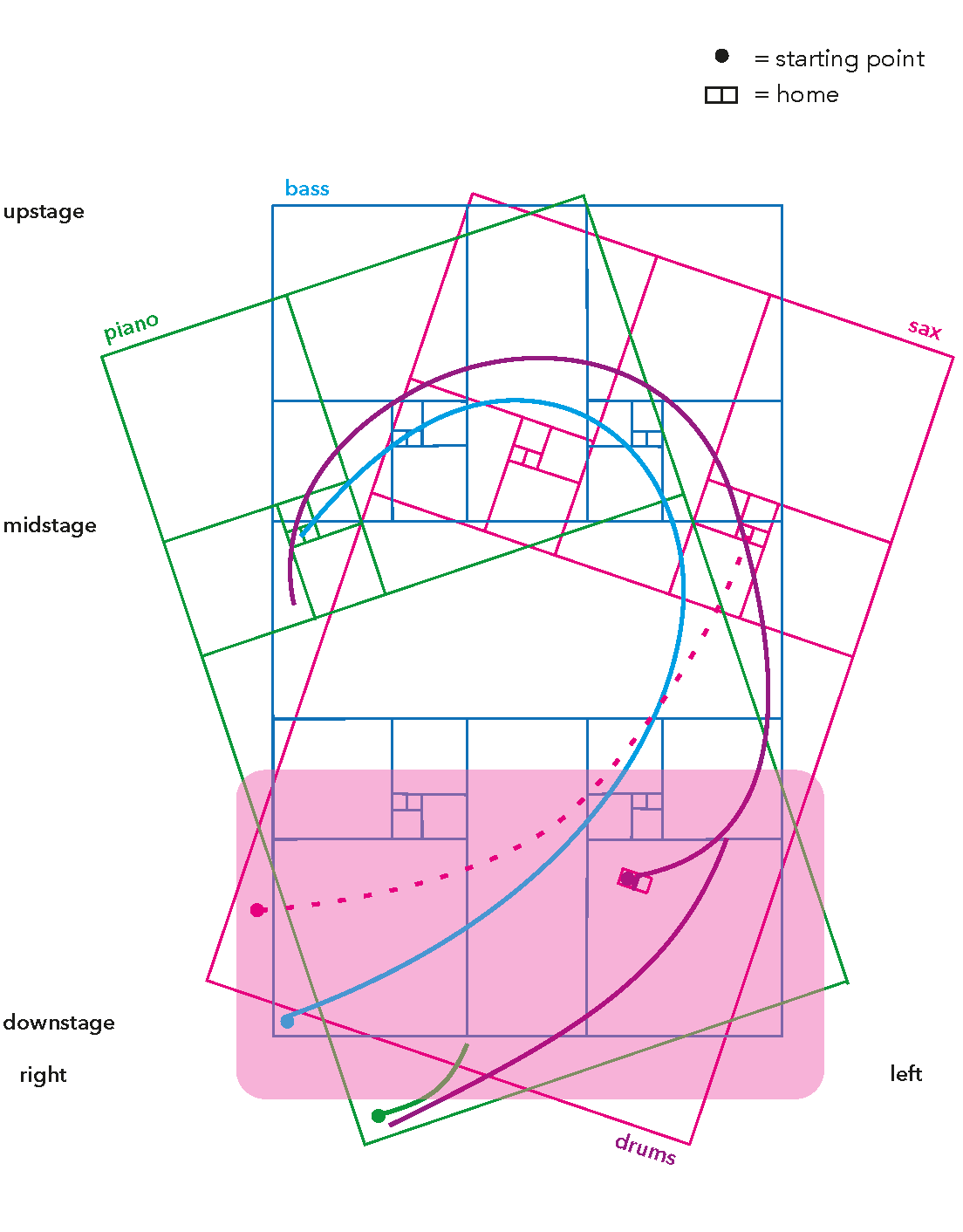
Figure 7a: “Acknowledgement”: floor map.
Figure 4a and b: P row (extended) and R row. © Daphne Leong
In literal space, the Love Supreme dancers spiral through three rectangles (representing the Fibonacci series) taped on the dance floor. The paths, again, are the same but offset, staggered and inverted in time—pulling space open. Figure 7 shows the rectangles (color-coded online).33 Each dancer uses one rectangle: as labeled on the figure, the bass uses the middle, the piano the left-slanted, the saxophone the right-slanted, and the drums (labeled on the bottom) the right-slanted, but with the small squares flipped to the lower half. The smallest squares in the rectangles are “home.”
The row structure from figure 4 is traced in the spirals of figure 7. Figures 7a, 7b, and 7c show the spirals for the three sections of figure 4 respectively: the first two row forms (figure 4a and b), the middle three (figure 4c, d, and e), and the final two (figure 4f and g). Each row form is represented by movement one way (upstage or downstage) on a spiral; except for the final P (on “a love supreme”), P rows move upstage and R rows downstage. (The curves on the figure are approximate, based on the video of the full performance; Sanchis described them to me as spirals moving through the Fibonacci squares, from the 1-1 “home” through the squares representing 2, 3, 5, 8, 13, 21, and 34—or in reverse.34)
In the opening P and R rows (figure 7a), the bass spirals from his rectangle corner at downstage right to his “home” and through to the “home” of the left-slanted rectangle, then back in retrograde. The drums accompany the bass’s motion, beginning at “home” on his rectangle.35 The saxophone begins at his downstage right rectangle corner, and dances much of this portion of the movement freely in the front third of the stage, represented by the shaded area on the figure. The piano begins at the downstage right corner of his rectangle; after the saxophone enters, the piano dances on the line between the saxophone and the others.36 Figure 8 shows bass and drums upstage (at cell 15 in their spirals), saxophone downstage, and piano on the line between bass/drums and saxophone. By the end of the section, the bass and drums have returned downstage, and the saxophone reaches his “home,” midstage left. (The dotted line on figure 7a shows the saxophone’s eventual trajectory.)

Figure 8: Acknowledgement”: Stage locations. Bass and drums upstage (cell 15); sax downstage; piano on line between. Photograph by Anne Van Aerschot. © 2019 by Rosas.
The following group of three row forms (figure 7b) begins (P) with bass and drums spiraling from downstage to upstage, as before, and the saxophone moving downstage from his “home.” For the partial row forms that follow, bass and drums begin their spirals back towards downstage (R23-10), but do not complete them, remaining at the back half of the stage and returning (P10-23) to their “homes.” Thus, for this middle portion of the movement, the saxophone solo remains at the forefront and the rhythm section in the background.
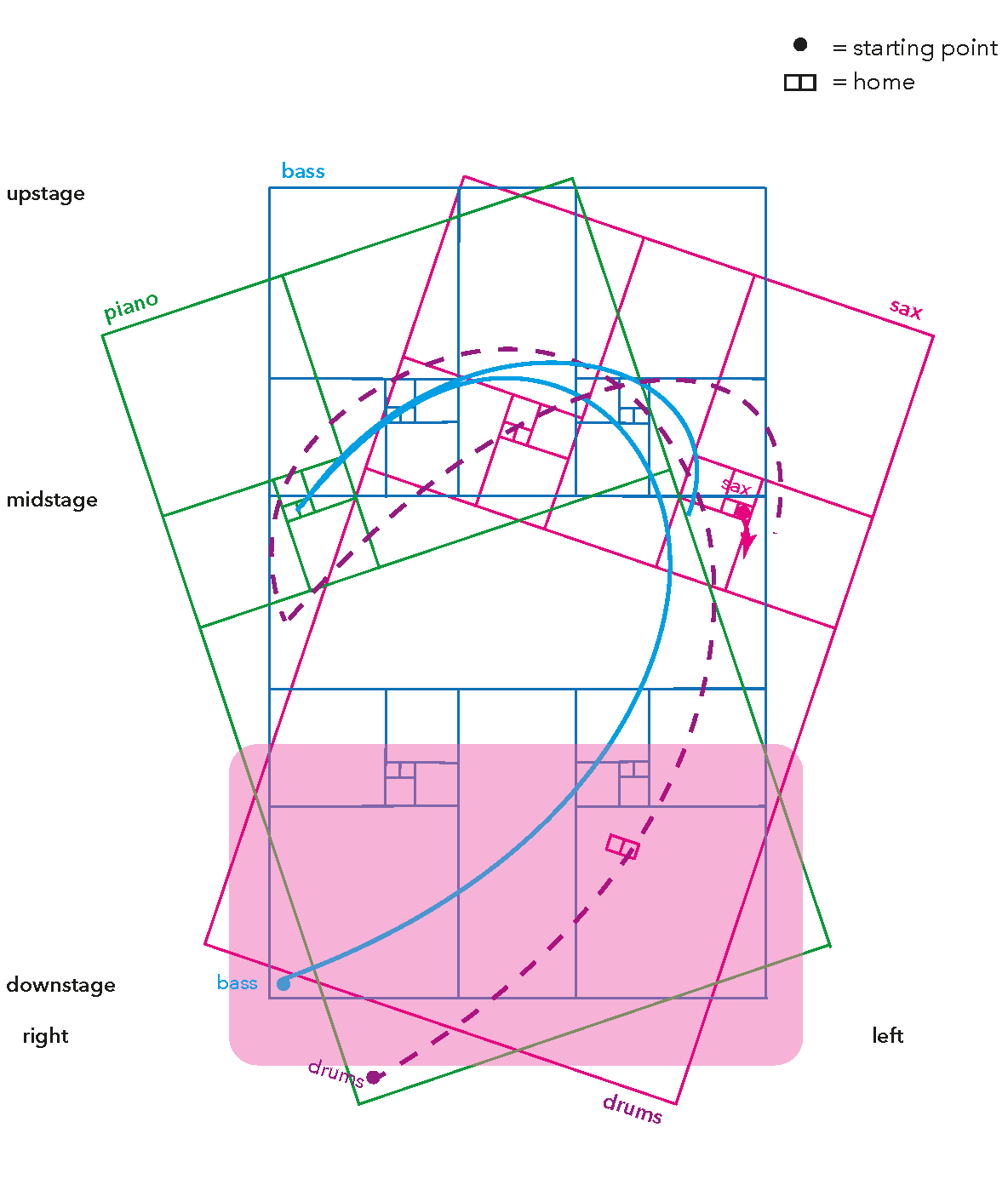
Figure 7b: “Acknowledgement”: floor map. Figure 4c, d, e: P and partial R and P rows. © Daphne Leong
The final two row forms (figure 7c) correspond to the ostinato chain and the chanting of “a love supreme,” respectively. The rhythm section dances in unison. For the R row form, the three instruments begin upstage right, on the outer endpoint of their spirals, and dance back a short distance to their “homes” (indicated by diamonds on the figure). During the P row form, the three instruments return to the downstage points from which they began “Acknowledgement,” while the saxophone spirals upstage, all four dancers now dancing in unison. The saxophone is soon to exit: at dance cell 10 the saxophone and the rhythm section cross over, the saxophone now dancing behind the rhythm section; after reaching the middle rectangle “home” (dance cell 20), he exits.
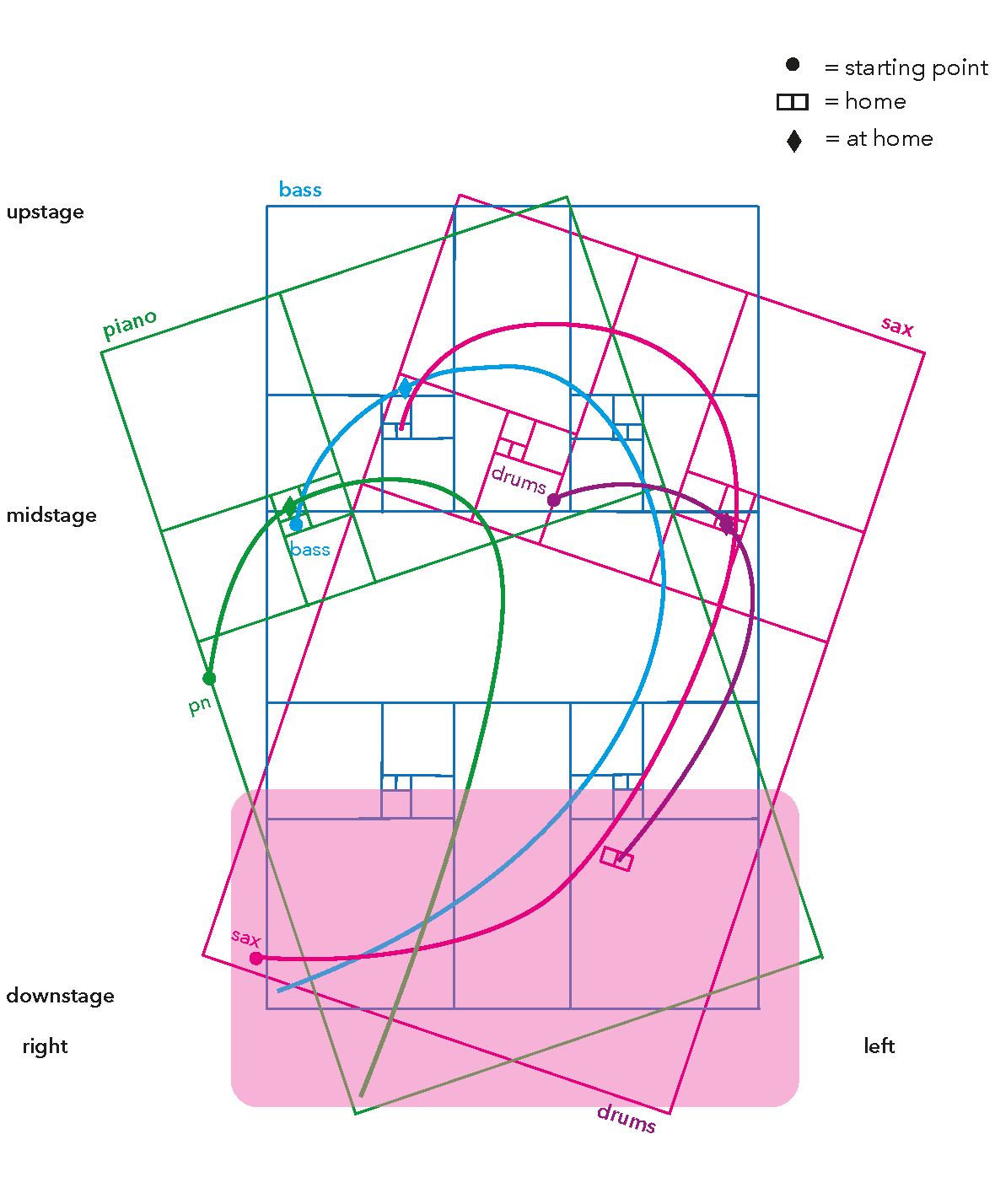
Figure 7c: “Acknowledgement”: floor map. Figure 4f and g: extended R row (ostinato chain), and P row (chanting “a love supreme”). © Daphne Leong
The basic spatial trajectories in “Acknowledgement” are thus very simple: bass, drums, and saxophone spiral from downstage right to upstage right, and in reverse, with the rhythm section doing so at twice the speed of the saxophone, and in the opposite direction, and with all instruments skewed left or right from one another. The same trajectory is thus paralleled but counterpointed through differences in time, space, and degree of freedom.
So, in “Acknowledgement,” the dance simplifies musical relationships and processes, portraying musical roles among soloist and rhythm section through physical space and freedom and quality of movement. It articulates the musical progression towards Coltrane’s ostinato chain—and ultimately his chanting of “a love supreme”—through the presentation of the dance phrase at different levels of literalness. The formal process—bass, drums, and piano entering one at a time, in unison; splintering into different levels of improvisation on the basic phrase when the saxophone enters; then eventually building back towards unison dancing, one instrument at a time, culminating (at the climactic chanting) in all four dancers in the full P dance phrase—sets out a clear formal structure, foreground-background relations, and unified though qualitatively differentiated movements. It thus, in Sanchis’s words, “frames the music and points at what is happening already”; rather than adding complexity it aims to make the music more readable.37
IV. “Psalm”
Unlike “Acknowledgement,” in which prepared and improvised processes loosely parallel one another in dance and music, in “Psalm” carefully choreographed dance interprets open, improvised music. The contrasting approaches in “Psalm” paradoxically allow the choreography to reflect, on a deep level, much of the spirit and structure of the music.
Preaching the text
The music of “Psalm” is freely improvised without set meter, harmonic progression, or fixed form, in the modal framework of C melodic minor. As Lewis Porter has shown, Coltrane vocalizes, on his saxophone, the words of the psalm that he has published in the liner notes. The playing is almost syllable for syllable.38 Porter describes its pitch structure and relates it to the tradition of black American intonational preaching:
Each section of several lines has an arched shape—an ascending phrase, a recitation on one tone, and descending phrase. The recitation tones ascend as the piece builds in intensity. The roots of this solo seem to grow out of formulaic procedures used by preachers in black churches. […] Jeff Titon, in his paper “Tonal System in the Chanted Oral Sermons of the Reverend C.L. Franklin,” describes the procedure of black American preachers for intonational chant. The chant is divided into sections according to pitch apexes, for which we may use the more familiar term recitation tones.39
Porter’s description is largely accurate, but pitch apexes need not function as recitation tones (though they often do). Figure 9 displays my transcription, in pitch and time, of Coltrane’s line, taken from the iconic 1964 recording.40 Most of the highest pitch apexes involve recitation, but apexes 3 and 4 (indicated in diamonds) do not. As Porter has shown, “reciting,” particularly on scale degree 5 (G4 and G5) and to a lesser extent, scale degree 1 (C5), plays a prominent role. Coltrane often begins a section by rising to an apex on E♭4, followed by an apex on G4.41 The line ascends to progressively higher points—C5, E♭5, and ultimately G5—accompanied by increasingly lower descents (dropping the initial “floor” of C4 to G3 and even F3). The drama is intensified through ever more extended and complex climbs and falls.
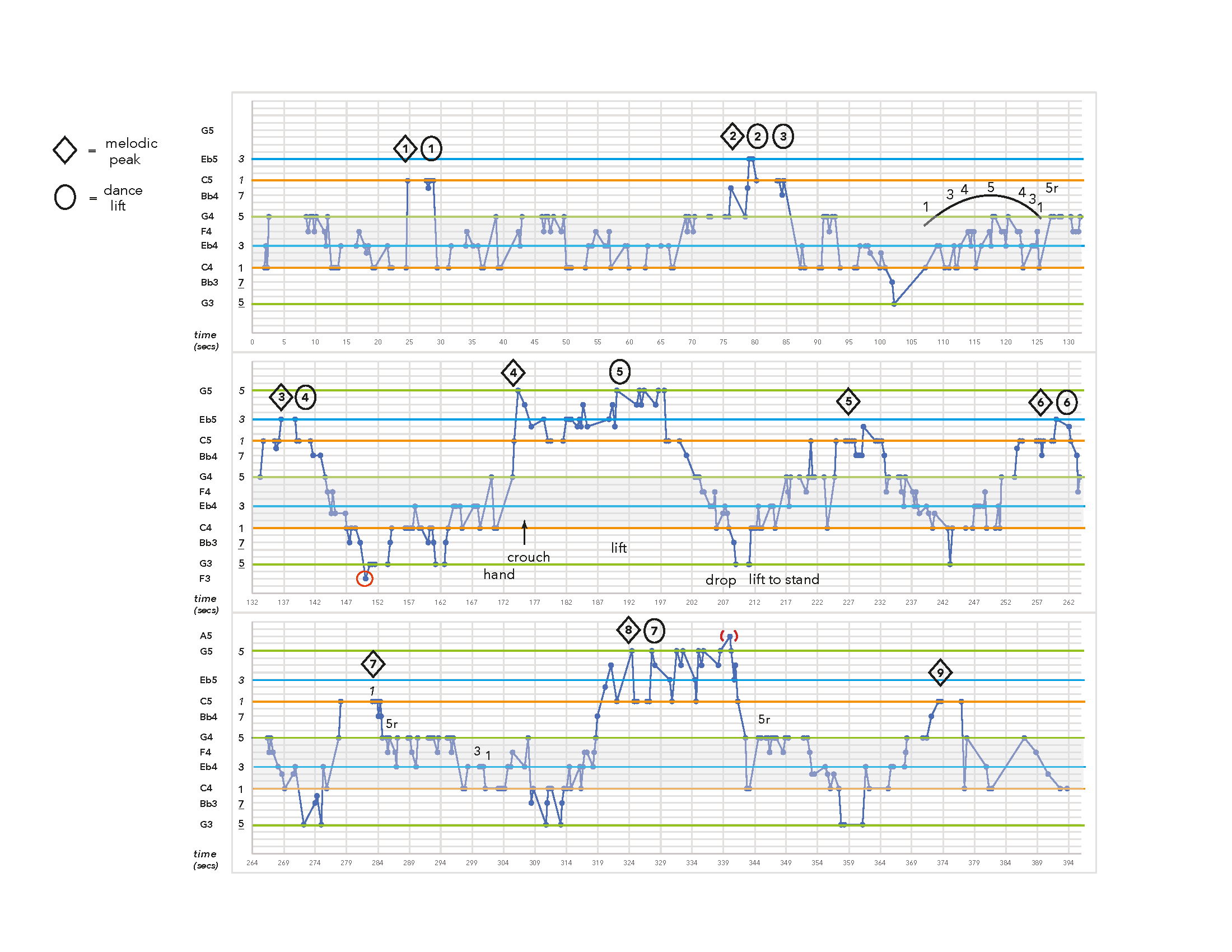
Figure 9: “Psalm”: pitch-time transcription, saxophone line. © Daphne Leong
The general phrase types of Reverend Franklin’s preaching, described by Titon, also apply to Coltrane’s line: “By its music, Franklin’s chant falls into three types of […] musical phrases: auxiliary, main, and secondary phrases.” An auxiliary phrase is “brief and formulaic (e.g. ‘O Lord’), tends to gain Franklin time, and establishes the tonic pitch by ending strongly on the tonic.” A main phrase “starts at or quickly rises to the pitch apex […] and then falls toward the tonic, usually by thirds (e.g., 5-3-3-1).” A secondary phrase “follows a main phrase and has a pitch apex below the preceding main phrase’s pitch apex, usually a minor third above the tonic. Secondary phrases usually end on the tonic.”42 (These phrase types will be referenced below.)
In this tradition of black American preaching, intonational chant provides the emotional climax—“the sweet spot”—at the end of the sermon. In A Love Supreme, “Psalm” is the final movement, the intense close to a four-movement suite. As with intonational chant, it arises out of what precedes: it was recorded as a single track together with the third movement. As a “psalm,” a song sung to musical accompaniment and a deeply personal yet communal expression of faith, Coltrane’s vocalization resonates with the black American practice of intoning not only sermons, but also extemporaneous prayers.43
Pitch contour
I begin by tracing the features of Coltrane’s melodic contours, relating them to their source text and to the preaching phrase types. The detailed description of phrase shapes and timbres prepares the subsequent discussion, which shows how Sanchis and de Keersmaeker’s choreography dramatizes Coltrane’s pitch peaks and floors.
Coltrane’s line, in C melodic minor, uses both B♭ and B♮. D appears rarely, and A♭/A never (with the possible exception of an A5 hinted at near the end). Scale degrees 1, 3, and 5 predominate; the core ambitus (shown in grey on figure 9) orbits {C4, E♭4, G4}. In the following, musical examples without rhythmic values transcribe Coltrane’s note onsets proportionally.44 Reference will be made to the pitch-time graph of figure 9, with locations identified in seconds („).
The movement opens by introducing its fundamental features. As shown in music example 2a, Coltrane begins with the psalm’s title, “A Love Supreme,” arpeggiating upwards through the core pitches. Though set apart from the poem’s body, the title, together with the opening lines (“I will do all I can to be worthy of Thee O Lord. It all has to do with it. Thank you God.”), form the first musical phrase. The pitch shape is classic: ascent through scale degrees 1-3-5 to recitation on 5, followed by descent to 1; “Thank you God” (Titon’s “auxiliary phrase”) is played on the formula 3-1-1 (later also 5-1-1 and other variants).
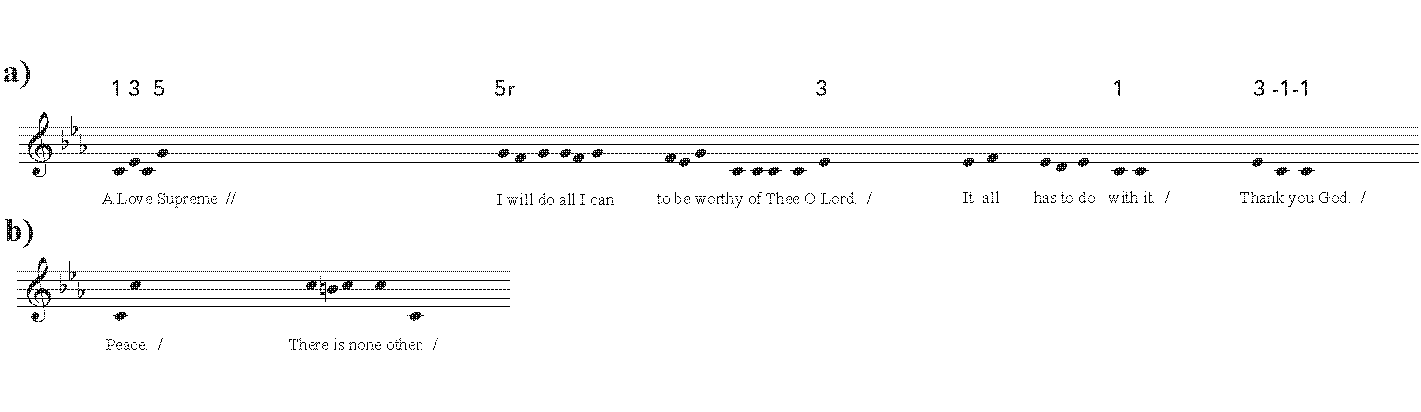
Music example 2: “Psalm”: Phrase 1 and Peak 1. © Daphne Leong;
Click to listen (0:00-0:30): https://youtu.be/gta2GOqvjVE?list=RDgta2GOqvjVE
Nine pitch peaks follow (defined here as ascents to C5 or higher), labeled in diamonds on figure 9. The first, as shown in music example 2b, is a simple octave leap C4-C5 on the word “Peace,” leaping back down almost immediately on “There is none other.”45 Motion to successive pitch peaks becomes increasingly complex.
Peak 2 (music example 3) is reached more gradually, arpeggiating through 1-3-5r-7, reaching up a diminished 4th to 3, falling back immediately to 1 (C5). The words are “We know. God made us so. Keep your eye on God. God is. He always was. He always will be” (climactic clause underlined). Although this pitch peak, E♭5, surpasses C5, it is but an embellishment of the basic motion B♮4-C5. Coltrane again almost immediately drops back down the octave to C4, but then expands the descent: from the high 1 he arpeggiates slowly through 5r-3-1 and then, for the first time, drops below C4, to 5.46 At this nadir, on the phrase “It is most important that I know Thee.” (lowest point underlined), Coltrane pauses for almost five seconds.
This drop sets in motion two extended and complex ascent-descents. As shown on figure 9 (just after 105 seconds), the ascent to Peak 3 begins with a slow arc 1-3-4-5-4-3-1. The melodic incantation is inspired by the fragmented nature of the words: “Words, sounds, speech, men, memory, thoughts, fears and emotions—time—all related … all made from one … all made in one. Blessed be His name.” The arc builds to recitation on 5 (“Thought waves—heat waves—all vibrations—”), which leaps up to C5 and then E♭5 (“all paths lead to God”). From this peak, Coltrane wends his way down through a series of ellipses “His way … it is so lovely … it is so gracious” arpeggiating a Gmin7 chord, bringing new emphasis to the notes B♭, D, and especially F—the latter providing the nadir (F3, circled) of Coltrane’s entire soliloquy. This sweeping descent through almost two octaves prepares the dramatic ascent to follow.
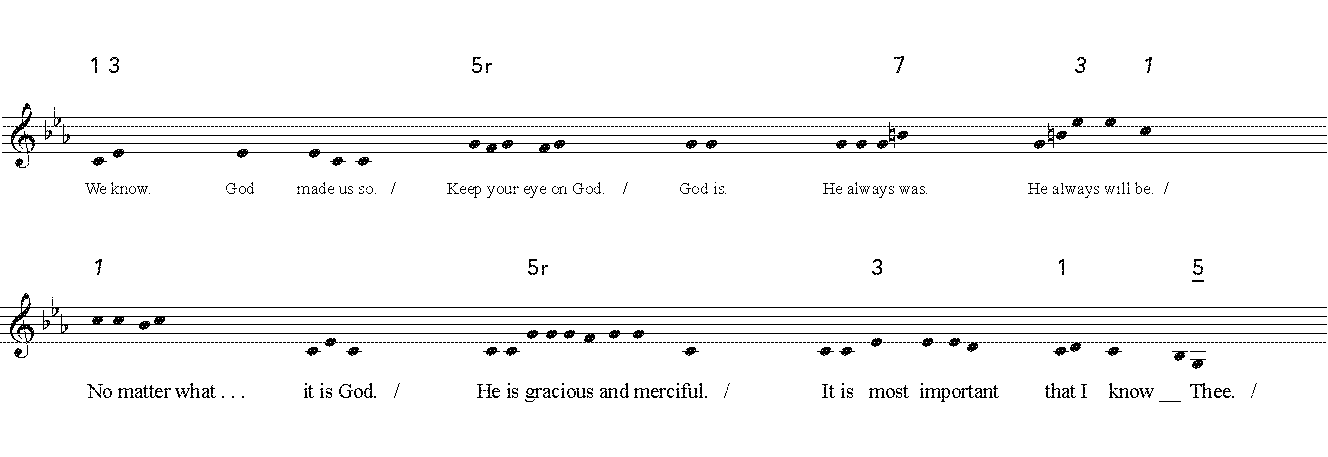
Music example 3: “Psalm”: Peak 2. © Daphne Leong;
Click to listen (1:01-1:44): https://youtu.be/gta2GOqvjVE?list=RDgta2GOqvjVE&t=61
The ascent to Peak 4 (music example 4) begins with “Thank you God,” not on 3-1-1 or 5-1-1 as usual, but rising through 5–7-1. This ascent is repeated to fuel a slow rise through 5-1-3-5 (“and they all go back to God … everything does. Thank you God.”) “Have no fear” then inspires two bold leaps upwards (5-1–5), attaining G5, the movement’s apex, and falling only slightly, to C5, through “believe … Thank you God.”
Coltrane sustains this climax, rising again slowly (1–2) through “The universe has many wonders” before accelerating to G5 (3-4-5) on the words “God is all,” and reciting, for the first time, on altissimo G5 (“His way … it is so wonderful.”) The slow descent to follow traverses every step of the C scale from C5 to G3 (except A/A♭, which does not feature in Coltrane’s line in this movement).
One large peak remains, but Coltrane scales back before reaching it. As shown on figure 9, the next two peaks recite on C5 for the first time, Peak 5 touching on D5, and Peak 6 reaching E♭5.
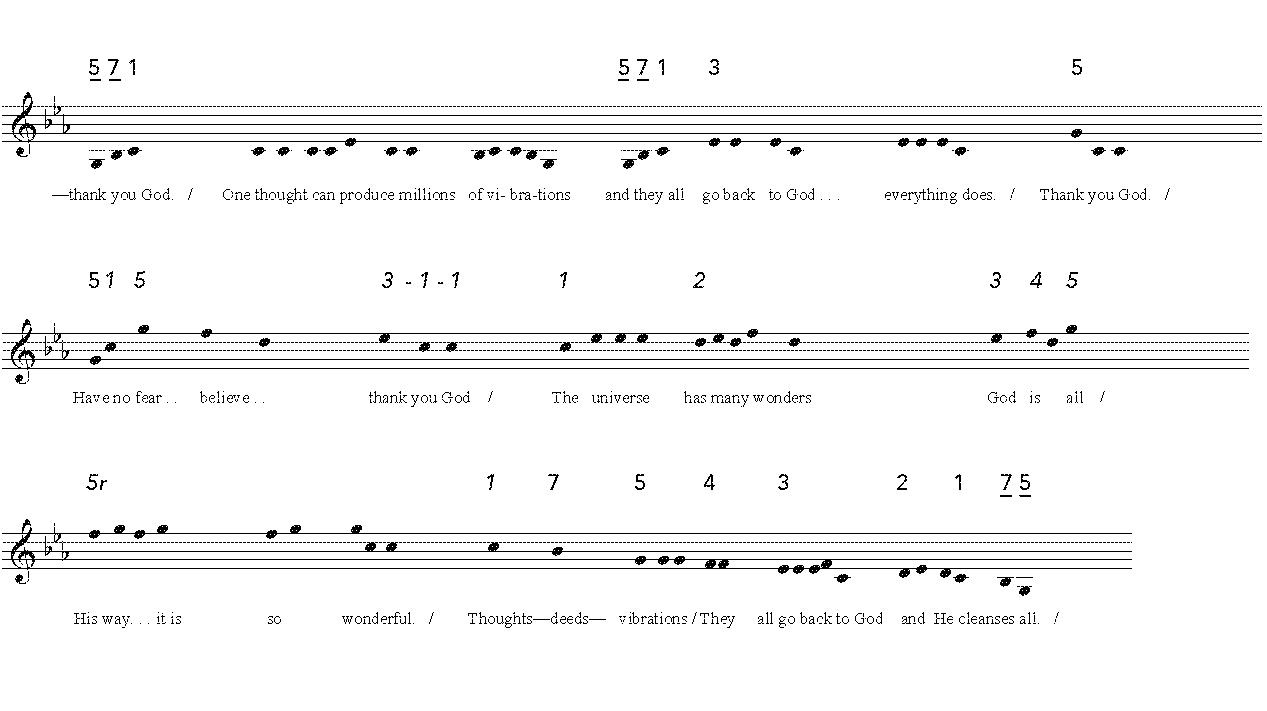
Music example 4: “Psalm”: Peak 4. © Daphne Leong; Click to listen (2:33-3:30): https://youtu.be/gta2GOqvjVE?si=UXbDPVSgV-5f_fWv&t=153
Peak 7 differs from all of the other peaks, and this distinction results, in part, from what happens during the descent from Peak 6. The text (“Let us sing all songs to God To whom all praise is due … praise God.”) contains the psalm’s only explicit mention of music. For the first and only time in the movement, as shown in music example 5, drummer Elvin Jones establishes a clear duple pulse—he even articulates a straightforward four-bar hypermeter (four bars of 4/4).47 Inspired, perhaps, by the new rhythmic context, Coltrane colors this phrase richly with pitch bends and slides, and with a singular A♯ leading to B. The durational and pitch emphases of his melodic line suggest a displacement of Jones’s meter, by one quarter note later (shown above the music example). The melodic line comes to rest on C4; the final “praise God” with its apparent ascent (G4-C5) is but an “auxiliary phrase”—the only such phrase to rise to C5.48
Thus it is the C5 that follows (“No road”) that forms the true peak. Articulated with renewed vigor by Coltrane, it forms the arrival point of Jones’s dramatic rallentando, resolving the displacement dissonance between Coltrane’s melodic line and Jones’s meter. This peak (figure 9, Peak 7, 283”) inaugurates a long descent (a stretched-out traversal of 1-5r-3-1) on “No road is an easy one, but they all go back to God. With all we share God. It is all with God. It is all with Thee. Obey the Lord. Blessed is He.” In differing categorically from the movement’s other peaks, Peak 7 and its approach prepare the way for the final climax.
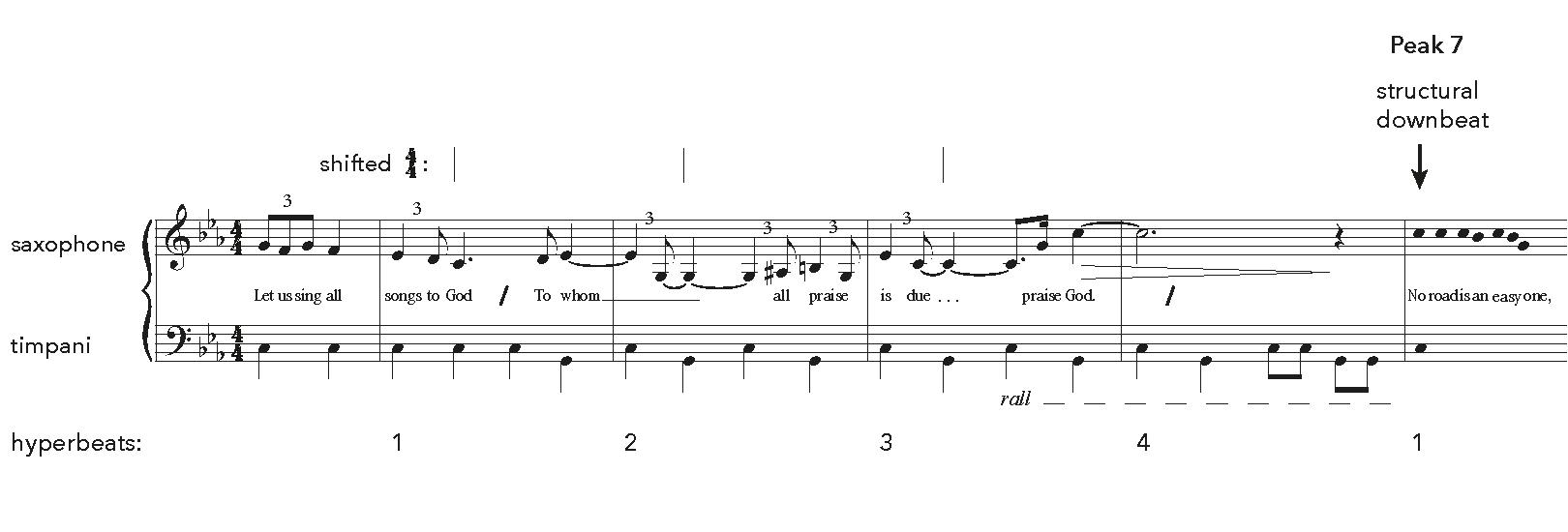
Music example 5: “Psalm”: Drop before Peak 7. © Daphne Leong; Click to listen (4:24-4:45): https://youtu.be/gta2GOqvjVE?list=RDgta2GOqvjVE&t=264
The ascent to Peak 8 (music example 6), as with the climactic Peak 4, requires two starts on G3-Bb3-C4 (here matching the parallel clauses “I have seen God—I have seen ungodly”). It rises through E♭4 (“none can be greater”) and then a Gmin7 arpeggiation (“none can compare to God”) to conclude on altissimo “Thank you God” (G5-C5-C5). At this peak of intensity, Coltrane, tone hoarse, draws out a recitation on G5, including not only the lower neighbor F5 as usual, but also quick arpeggiations to E♭5-C5 on the climactic words “He will remake us … He always has and He always will. It is true—” An indistinct note (A5?) ends the recitation and cascades quickly down to G4-C4-C4 (“Thank you God”).
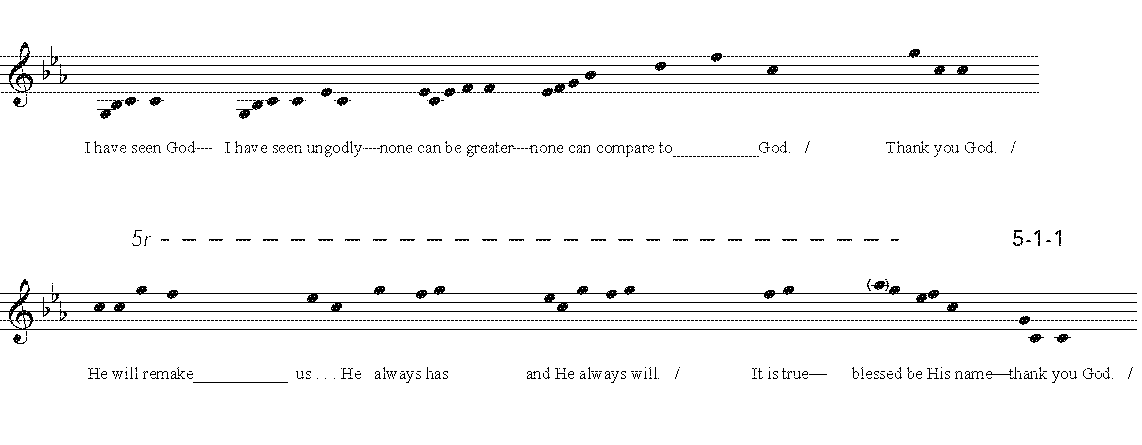
Music example 6: “Psalm”: Peak 8. © Daphne Leong; Click to listen (5:10-5:44): https://youtu.be/gta2GOqvjVE?list=RDgta2GOqvjVE&t=310
As shown on figure 9 (344”), a lengthy recitation on G4 (the basic recitation tone) begins to close out the movement. There remains but one final, brief peak on Coltrane’s laud “ELATION—ELEGANCE—EXALTATION”: an arpeggiation from C4 to C5 and back (Peak 9). The movement closes with a final “Amen.”
“Carrying the other”
The choreography adds literal and symbolic dimensions to Coltrane’s rising and falling line. It also foregrounds the relationship of the musicians—and the dancers—to one another. From the opening sound, it is clear that the fourth movement will differ from the preceding ones. Elvin Jones chooses timpani (supplemented by Chinese cymbal) over drumset, and the resulting resonance creates a sonic space in which Jones’s, Garrison’s, and Tyner’s sounds envelop and amplify Coltrane’s leading melodic line.49 The communal nature of the sound space is illustrated by the four musicians’ opening pitches (music example 7), which articulate the lowest partials (overtones) of Garrison’s plucked C2 almost exactly (Coltrane plays E♭4 rather than E♮4).
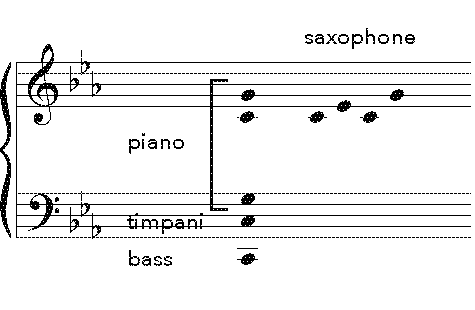
Music example 7: Sonic unity in “Psalm”: opening pitches. © Daphne Leong
The dancers, likewise, no longer represent individual musicians, but the sonic whole.
It is certainly the first time the dancers touch one another. At this point they take leave of their personal struggles, and of their dance with gravity, and support each other. They help keep each other from falling. What’s more, they take turns lifting each other in an upward spiral reflecting the geometric pattern on the ground. The hierarchy between them is entirely suspended; each is freed from gravity, in a sense. This is about taking care of each other by carrying the others with a high degree of physical empathy.50
This choreography to “Psalm” seems to reference contact improvisation, the dance movement perhaps best known for experimenting with falling, with gravity, and with shared weight.51 Even the slow-motion aspects of some of the ensemble dancing resonates with the slow motion used “to elucidate the act of falling” in film chronicling contact improvisation.52 Here, the slow motion reflects the strain and fatigue expressed by Coltrane’s tone, as well as “the dancers’ physical state at this point in the performance. They are moving slowly after a long and very exhausting explosion of energy that makes them thoroughly human […].” The physical fatigue lends the scene weight; the dancers “don’t need to pretend.”53
Just as Coltrane’s melodic utterances call to mind black American preaching, so too do the dancers evoke sculptural images (figure 10). “You recognize iconic images remembered from art history, without necessarily being able to name them. To that end they are not too specific or concrete, nor too abstract. Ultimately they are dancers lifting each other up.”54 The musical and danced references are both transcendent and specific, archetypal and in the here and now.
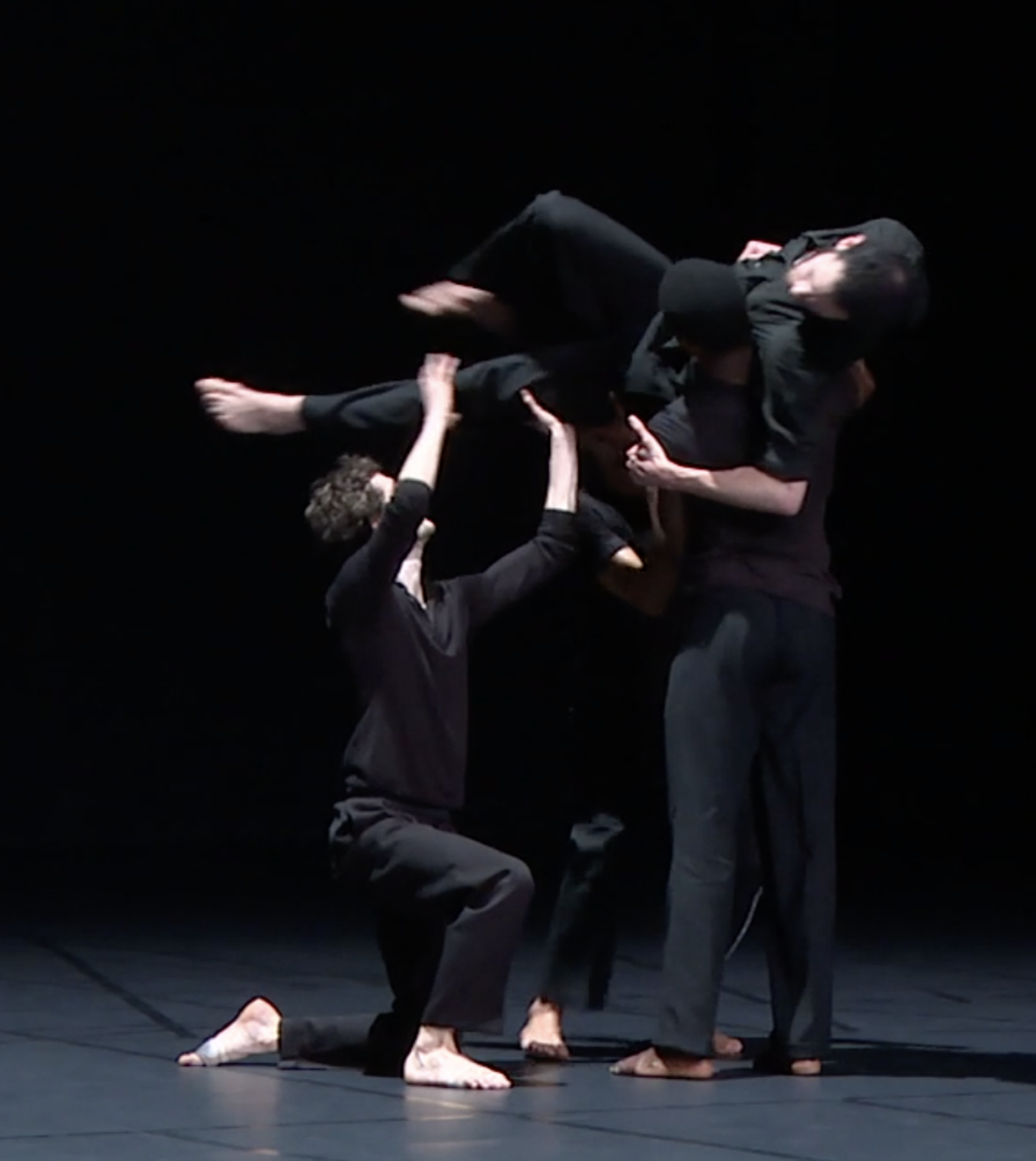
Figure 10: “Psalm”: Sculptural image (Lift 1). © 2019 by Rosas
Coltrane’s verbal “psalm,” too, is at once concrete and unnamed. The liner notes are cryptic: in a letter to the listener, Coltrane writes, “The fourth and last part is a musical narration of the theme, ‘A Love Supreme’ which is written in the context; it is entitled “PSALM.” The reference, of course, is to the long poem, also printed in the liner notes.55 But even Coltrane’s fellow quartet members seemed unaware of the text’s role: in speaking with Ashley Kahn about the Love Supreme recording session, pianist McCoy Tyner and drummer Elvin Jones focused on how little information Coltrane typically gave them. A text was not mentioned.56 To Lewis Porter, “Elvin Jones indicated […] that he was unaware that Coltrane was reciting the poem on his saxophone.”57
Coltrane himself, in the live performance at Antibes, France several months later, discarded his syllabic declamation for instrumental virtuosity.58 Speaking at Antibes about his musicians, Coltrane said, “I never have to tell them anything. […] There is a perfect musical communion between us that doesn’t take human values into account. Even in the case of Love Supreme, without discussion, I don’t go any further than to set the layout of the work.” Coltrane then describes the framework of “the last part,” “the first part,” and “the central part,” that is, of III. “Pursuance,” I. “Acknowledgement,” and II. “Resolution”; he does not mention “Psalm” separately.59
Sanchis and De Keersmaeker ultimately read the movement as a testament to human relationship:
A dancer lifted up horizontally can mean different things: it can mean the person is dead, unconscious, sleeping, ill. In any case, at an abstract level, there is a sense of surrender, vulnerability, and so also trust. A Love Supreme suggests a love directed highly, at something that is ‘supreme,’ but also that the ultimate love is love for one’s neighbor. It is a love capable of suspending its own ego by carrying the other, whether literally or through a kind of communal playing like the quartet does, and communicating collectively.60
Here De Keersmaeker directly ties the dancers’ shared weight-bearing to the quartet’s “communal playing.”
Further, the music’s multi-racial embodiment in Vantuycom, El Had, dos Santos, and Respilieux, in 2017, puts faces to De Keersmaeker’s statement: “When you are dancing to music that is so powerful, you inevitably embody an idea of what it means to be human.” “During the working process,” said Sanchis, “we talked a lot with the dancers about what transcends us. […] There is something out there that we humans plug into, independently, all around the world. […] It’s about an experience of the world that predates language. That’s why I often find musicians tremendously spiritual, probably because they can communicate beyond the regular language system, and can express experiences that are beyond the linguistic.”61
Although it is beyond the scope of this chapter, race plays a complex role in this work. In the identities of the classic quartet (Coltrane, Tyner, Garrison, and Jones) as black jazz musicians, in the final movement’s indebtedness to the black American intonational preaching tradition, and ultimately in the album’s significance as an archetypal symbol, on the one hand, of African American experience and, on the other, of universal values,62 A Love Supreme stands for much more than its acoustic trace. Pair this with the Spanish and Belgian background of the two choreographers, the Belgian base of De Keersmaeker’s dance company Rosas, and the international identities of the four dancers (Dutch, Moroccan, French, and Brazilian)—and the danced Love Supreme is truly transnational, yet deeply grounded in both African American and European traditions.
Dance contour
The synthesis of sound and dance also unites the ineffable and the concrete. The metaphor of pitch rise and fall plays into the dancers’ bodily lifts, and into their play with and against gravity.
One can’t dance in such a way that one leaves the ground we stand on. Dancers are bound to the laws of physics […]. This renders dance abstract and concrete at the same time: bodies moving in time and space, with gravity as their grounding, counterforce, and restriction.63
I use the word “contour” here in parallel to pitch contour—that is, to refer to the vertical dimension of the dance. Specifically, I will discuss lifts at or above the level of the shoulders, and drops to the floor. All such lifts are labeled in ovals on figure 9. Each of pitch peaks 1-4 (rising through C5, E♭5, and G5) is choreographed with an ensemble lift at or above the level of the shoulders. After attaining the highest melodic apex at Peak 4 (G5), each subsequent peak higher than C5, that is, Peaks 6 and 8 (E♭5 and G5 respectively), also receive such an ensemble lift.64 Each lift differs in motion quality and character, and together with the line unfolding in music and dance, narrates emotion and story.65
In the chart below, I list the primary lifts and drops. The descriptions on the right should be considered part of the main text of this chapter. The reader is invited to read each description in tandem with the corresponding musical example, and then to watch the accompanying video. (The video examples in the chart have been replaced with the images listed in the leftmost column; audio links are found in the second column.)
| Image | Example | Peak | Lifts and Drops | |
|---|---|---|---|---|
| Fig. 10 |
M.Ex. 2b |
Peak 1 |
Lift 1 (Vantuycom) On this first, straightforward melodic leap up the octave and back down, C4-C5-C4, dos Santos lifts Vantuycom in a circular turn, putting him back down as the pitch drops back down the octave. |
|
| M.Ex. 3 (“He always was.”) | Peak 2 |
Lifts 2 and 3 (El Had, Respilieux) El Had and JRespilieux are lifted in turn, El Had corresponding to the Eb5 apex, and Respilieux to the C5 that immediately follows, each being put back down as the pitch descends. |
||
| Fig. 9 (132″-) | Peak 3 |
Lift 4 (Vantuycom) With circling at multiple levels, this lift happens just after the pitch apex Eb5, on the C5’s of the “Thank you God” melodic formula. |
||
|
Drop: Floor (dos Santos) As Coltrane reaches C4, and drops to the nadir C4-Bb3-F3-G3 to conclude the phrase, dos Santos slides to the ground. At the beginning of the next phrase, G3-Bb3-C4, the other three dancers huddle low over dos Santos. |
||||
| Fig. 9 (162″-) | Peak 4 | Crouch then Lift 5 (Vantuycom) | ||
| Audio: https://youtu.be/gta2GOqvjVE?t=162 | Crouch: On the C4 just before the bold leaps upward, Respilieux stretches his arm out, hand on Vantuycom’s chest, both dancers’ weight on that hand, before Vantuycom crouches down in anguish, fists to his face, on Coltrane’s F5 (G5-F5-D5). | |||
| Lift 5: At Coltrane’s leap back up to G5 (F5-D5-G5r) Vantuycom is lifted high on his back, almost as if dead, held motionless for the held G, and gradually turned during the recitation. | ||||
|
Drop: (Vantuycom) As Coltrane reaches Eb4-Eb4-F4-C4, and drops further to the G3 ending the phrase, Vantuycom begins to fall, and ends almost prone, on his back parallel to the floor, as Coltrane’s tone diminuendos to a dusky G3. |
||||
| Fig. 11 |
Rise to Peak 5: Lift to standing (Respilieux) Coltrane’s tone becomes more energetic as he begins the rise from G3. As Respilieux pulls Vantuycom up, Respilieux’s weight brings him to the floor, where he lies as if dead or ill, until his three friends lift him to standing on the G4 recitation. |
|||
| Peak 5 | Jump downwards (Vantuycom) | |||
| Fig. 12 | Peak 6 |
Lift 6 (Vantuycom) Vantuycom is lifted on all fours. |
||
|
M.Ex. 5 |
Drop & Peak 7 |
Pull up (El Had) We have already discussed how this drop and Peak 7 stand out, particularly because of the hypermetric underpinning of the timpani. The choreography responds to this pacing as well as to the G4-C5 tag and to Peak 7. Hyperbeats are marked on music example 5. |
||
| At hyperbeat 1 and during Coltrane’s scalar walk from 5 down to 1, Vantuycom and El Had entwine arms and lean on one another, walking backwards. They release their mutual hold at hyperbeat 2. At hyperbeat 3, where the phrase cadences melodically (Eb4-C4), Vantuycom and El Had slide to the floor. They mark the syncopated ascending tag (G4-C5) with a rapid leg/head motion, while in prone position. Since the phrase has already completed melodically, hyperbeat 4 is not articulated choreographically. Rather, to lead to the following structural downbeat, Vantuycom somersaults to standing and El Had rolls onto his back. | ||||
| At the structural downbeat and true peak (C5), Vantuycom, in a striking gesture, curves his hands down to meet El Had’s outstretched hands, grasps them, and pulls El Had up. This marked “lift” presages the final climactic peak to come. | ||||
| Fig. 13 |
M.Ex. 6 |
Peak 8 |
Lift 7 (Vantuycom) This is the most extreme of the pitch peaks. Coltrane recites for about 15 seconds on altissimo G5, his tone hoarse and breaking just before the final G5. For this lift, a bent and bowed El Had carries Vantuycom on his back, turning laboriously. |
|
| Peak 9 | The dancers have separated, no longer touching one another. We will see how this plays into the overall form of the choreography. | |||
Table 1: “Psalm”: Peaks and Lifts

Figure 11: Respilieux descending as he pulls up Vantuycom. Photograph by Anne Van Aerschot. © 2019 by Rosas

Figure 12: Lift 6. Photograph by Anne Van Aerschot. © 2019 by Rosas

Figure 13: Lift 7: El Had carrying Vantuycom. Photograph by Anne Van Aerschot. © 2019 by Rosas
To summarize, Peaks 1-3, which move upwards from C5 to E♭5, feature twirling lifts (of Vantuycom, El Had and Respilieux, and Vantuycom) fairly short in duration, matching the durations of the peaks. They culminate in Peak 4 (G5r), at which Vantuycom first crouches in anguish, and is then lifted up as if dead and held aloft. After this climax, Peaks 5-7 diminish in pitch height (D5, E♭5, C5). Peak 7 (C5), with a unique hypermetric setting, marks a structural downbeat with Vantuycom reaching down to pull up a prone El Had. This dramatic gesture presages the final climactic Peak 8, where a hoarse Coltrane, reciting on altissimo G5, is matched by a weary El Had, bearing Vantuycom on his shoulders. The most emotionally laden images—Vantuycom as if dead (Lift 5) and Vantuycom borne by El Had (Lift 7)—mirror the emotional intensity of Coltrane’s highest recitations and the sonic drama surrounding them.66
All major pitch peaks in the movement are represented by ensemble lifts, as described; there are no other ensemble lifts at or above the level of the shoulders. All of the lifts, except the last, involve all four dancers.67 The move to two dancers on the last lift is significant; Vantuycom and El Had mirror or parallel one another at the beginning of the movement and again at the end.
As shown in video 13, after El Had gently lets Vantuycom down, El Had is pulled back by his fellow dancers, opening out into the two-armed upward extension familiar from the first movement’s dance phrase. From this point onwards, the dancers no longer touch one another. A series of gestures recalls earlier ones, including dance gestures from the first movement’s basic dance phrase. The dancers exit one by one, first dos Santos, then Respilieux. When only Vantuycom and El Had remain, they dance a fragment referring directly to cells 15-18 of the P dance phrase, before El Had exits and Vantuycom concludes, again quoting cells from the original phrase (2, 18b). The cycle as a whole thus concludes by referencing the metaphorical source for the entire composition: “a love supreme.”
Ingrid Monson has discussed “the capacity of aural signs to signify in multiple directions—their ability to simultaneously constitute structure and a broader field of human relationships.”68 In “Psalm,” the choreography draws out the extremes of pitch contour in Coltrane’s oration, the raw timbres of the saxophone, and the striking sonic interdependence of the ensemble, embodying these musical interrelationships to powerfully signify deep human interconnection and mutual support.
Silent Prelude
The suite’s choreography begins with a thirteen-minute, danced, silent prelude—the dancers dressed as if warming up. As an opening of the space between music and dance, dancers and spectators, the silent prelude reverses the relation of music and dance. Here dance precedes music; it is dance that eventually ushers in sound.
The prelude consists of three traversals of fourth-movement choreography. The first traversal frames energetic third-movement material with the opening and closing of the fourth movement. It begins with the ensemble choreography of the fourth movement rotated to face the back of the stage; it ends with the closing sequence of the fourth movement, in which the dancers exit one by one, leaving only Vantuycom. In the second traversal, Vantuycom follows a task that reduces his fourth-movement material to an enigmatic succession of pedestrian movements: he stands, turns, walks, looks ahead/up/to the side.69 The extended sequence, full of pauses, includes a few stances identical to fourth-movement ones, in reverse order.70 The third traversal concludes the Prelude: Vantuycom dances the entire fourth movement alone (in spite of its ensemble premise); he omits some ensemble portions and adjusts others. His closing gesture—that is, the last gesture of the entire suite—thus functions at the end of the Prelude to wave in Coltrane’s opening fanfare. Video 14 shows a) the fourth-movement opening, b) the rotated fourth-movement opening that begins the Prelude, and c) Vantuycom’s solo version of the fourth-movement opening in the Prelude.
In rotating spatial orientation, transforming complex choreography into pedestrian movements, and reducing ensemble to solo dancing—all in silence—the Prelude begins A Love Supreme with a question—a space, as it were—“for the audience to read something, to place their experience.” In its silence, “it tunes our perception.”71
Conclusion
The suite encompasses a journey.72 Sanchis speaks of the “dramaturgical accessibility” of A Love Supreme; “it was a kind of spiritual revelation, […] a short opera of sorts.” He references its “intensity” and “expressive excess,” De Keersmaeker its “beautiful connection between joy and gravity.”73
The dance “opens up” Love Supreme in vastly different ways in the first and last movements.74 In the first, composed and improvised material in the dance responds to that in the music: the basic dance phrase to the bass ostinato and its verbal source, the dancers’ roles to the roles of jazz rhythm section and soloist. Vantuycom’s virtuosity embodies Coltrane’s. Unison dancing highlights the introduction and eventual transformation of the bass ostinato into the chanted “a love supreme.”
In the last movement, composed dance interprets improvised music. The dancers’ physical interdependence incarnates the musicians’ sonic unity. Bodily lifts and drops depict Coltrane’s melodic climbs and falls—further, they dramatize Coltrane’s timbral nuances and the musicians’ interplay.
In the first case, the structure of the dance embodies and simplifies that of the music, supplying a framework within which improvisation (in both dance and music) can be understood. In the second, the dance frames the music in concrete, affective, and spatial dimensions—telling a story of mutual human support. In so doing, it connects to both the visceral and transcendent elements of the music, and creates new spaces within which audience members can place their own readings.
-
I am grateful to Salva Sanchis for a generous video interview, 7 September 2020, which made this work possible. My thanks also to Sanchis and Hans Galle for making a video of the full performance of Love Supreme available. Photographs of Love Supreme choreography, by Anne Van Aerschot, are reproduced by kind permission of Rosas. Anya Cloud introduced me to contact improvisation and provided astute comments on a draft of this chapter; Keith Waters provided helpful feedback; and Kara Yoo Leaman gave insightful suggestions on an early version of this work (Daphne Leong, “Embodying Music: Three Questions from Practice,” plenary presentation, Society for Music Theory Annual Meeting [online, 2020]). I am grateful to Stephanie Schroedter for the opportunity to take this work further.↩︎
-
https://www.rosas.be/en/news/574-dancers-of-ia-love-supremei-win-the-iprix-de-la-critique-2017i-for-best-performers, accessed 15 June 2022. This chapter addresses the 2017 choreography. Sanchis both danced in and co-choreographed (with De Keersmaeker) an earlier version, Raga for the Rainy Season / A Love Supreme (2005) (https://www.rosas.be/en/productions/376-raga-for-the-rainy-season-a-love-supreme).↩︎
-
Sanchis, 2020 video interview with author.↩︎
-
Stephanie Jordan provides an excellent overview of work on dance-music relations, considering intermedia theory and choreomusical theory in the context of Western theater dance. “Mutual implication” is taken from Claudia Gorbman’s discussion of relations between music and image in film. Mariusz Kozak includes discussion of how dance-music relations contribute to connections between audience and dancer in De Keersmaeker’s Violin Phase. Stephanie Jordan, “Choreomusical Conversations: Facing a Double Challenge,” in Dance Research Journal 43/1 (2011): 43-64; see also Jordan, “Introduction,” in Music and Dance: Special Issue on Choreomusical Analysis, Journal of Music Theory 65/1 (2021): 3-9. Claudia Gorbman, Unheard Melodies: Narrative Film Music (Bloomington, IN: Indiana University Press, 1987), 15. Mariusz Kozak, “Anne Teresa De Keersmaeker’s Violin Phase and the Experience of Time, or Why Does Process Music Work?” in Music Theory Online 27/2 (2021).↩︎
-
“The improvising dancer tacks back and forth between the known and the unknown” (Susan Foster, “Taken by Surprise: Improvisation in Dance and Mind,” in Taken by Surprise, ed. Ann Cooper Albright and David Gere [Middletown, CT: Wesleyan University Press, 2003], 3-4).↩︎
-
In A Love Supreme, Jones plays drumset, timpani, and Chinese gong; I will refer to his instruments collectively as “drums,” per the usual jazz practice.↩︎
-
The second and third movements follow chorus structure: the second, “Resolution,” features a 24-measure theme “composed of three groups of eight measures” (with slightly altered endings), while the third, “Pursuance,” uses a fast 12-measure “minor blues” theme in B♭. Coltrane interviewed by Delorme and Lenissois, 1965, reproduced in John Coltrane, Coltrane on Coltrane: The John Coltrane Interviews, ed. Chris DeVito (Chicago: Chicago Review Press, 2010), 246; see also Lewis Porter, John Coltrane: His Life and Music (Ann Arbor: University of Michigan Press, 1998), 234-5.↩︎
-
The photographs (figures 3, 5, 8, 11, 12, and 13), by Anne Van Aerschot, are found in Salva Sanchis, Anne Teresa De Keersmaeker, and Rosas, A Love Supreme (Brussels: Rosas, 2019); they are reproduced by kind permission of Rosas.↩︎
-
For copyright reasons, we are not able to reproduce the dancers’ headshots. Please see Figure 3 for the dancers’ images. The photographs of Coltrane’s quartet (Coltrane, Tyner, Garrison, and Jones) are reproduced by kind permission of Chuck Stewart Photography.↩︎
-
The suite opens with a fanfare, which Sanchis and De Keersmaeker do not choreograph.↩︎
-
“Assigning the role of invoking both melodic line and rhythmic pulse to the bassist was nothing new for Coltrane”; “Olé” and “While My Lady Sleeps” are antecedents (Ashley Kahn, A Love Supreme: The Story of John Coltrane’s Signature Album [New York: Penguin Books, 2002], 100).↩︎
-
Lewis Porter, “John Coltrane’s ‘A Love Supreme’: Jazz Improvisation as Composition,” in Journal of the American Musicological Society 38/3 (1985): 612.↩︎
-
From excerpt of world premiere performance (2017) published online by Rosas.↩︎
-
Porter provides a transcription. He also documents Coltrane’s earlier interest in using Schoenberg’s twelve-tone method (John Coltrane: His Life and Music, 243, 231).↩︎
-
In Coltrane’s words: “I had one part that I was singing on […]—well not singing, chanting […].” Coltrane on Coltrane, 249. The first “a love supreme” is very faint.↩︎
-
It functions as what Jeff Pressing calls a “referent.” Pressing, “Cognitive Processes in Improvisation,” in Cognitive Processes in the Perception of Art, ed. W. Ray Crozier and Anthony J. Chapman (Amsterdam: Elsevier Science, 1984), 346.↩︎
-
Sanchis (2020 video interview) explained the term “dynamics” to me: “how you approach a shape, pass through it, and let it go.” It involves “continuity and momentum, play with balance, the motion of the body in space.”↩︎
-
Salva Sanchis and Anne Teresa De Keersmaeker, “An Improvisation with Gravity,” interview by Wannes Gyselinck, April 2017, in Sanchis, De Keersmaeker, and Rosas, A Love Supreme (Brussels: Rosas, 2019), 7.↩︎
-
Sanchis and De Keersmaeker, “An Improvisation with Gravity,” 7. It is common to use a dance phrase as the basis for improvisation: Susan Sgorbati provides an exercise in which a dance phrase is to be varied in multiple ways (repeating segments, retrograding; changing dynamics, textures, spatial patterns, etc.); Dana Reitz describes an exercise in which a short movement phrase is to be explored in different pathways; William Forsythe works with “set phrases of material that can be ‘operated on’ by dancers improvisationally”; to name just a few examples (Melinda Buckwalter, Composing while Dancing: An Improviser’s Companion [Madison: University of Wisconsin Press, 2010], 18, 23, 28). For a recent example, Sasha Waltz choreographs dance improvisation to Terry Riley’s In C by creating 53 sets of movement figures, corresponding to Riley’s 53 musical fragments. The dance was premiered in 2021 (https://www.nytimes.com/2022/04/26/arts/dance/sasha-waltz-in-c-bam.html, accessed 15 June 2022).↩︎
-
De Keersmaeker speaks of using a “limited and coherent choreographic vocabulary” for any given piece. “I generally organize in one or more basic phrases” composed of “cells” (which may be quite short or longer). The phrase may be perceived “like an ongoing variation, a variation without a theme”; it may be subjected to transformations such as retrograde, canon, mirror symmetry, fragmentation, repetition, and successive addition, techniques that De Keersmaeker borrows from musical practice, as a means of making limited material “fruitful.” “Chorégraphier Bach: incarner une abstraction,” lecture, Collège de France, 10 April 2019, 32:40 and 1h:04, translated by Daphne Leong (accessed 2 June 2020, https://www.youtube.com/watch?v=SHxf8d1an9I).↩︎
-
The basic dance phrase concludes just as Coltrane completes the pitch-class aggregate with F#. The transitional material comes from the movement’s closing gestures. While each dance cell takes up one measure in the ostinato-chain and chanting sections, this is not always true elsewhere.↩︎
-
Video 5: “Acknowledgement”: opening dance phrase. Click to view (1:19–2:37): https://youtu.be/Dog1egx5OTU?feature=shared&t=79↩︎
-
Cell 24, danced both forward and backward, takes up the space of a single cell between figures 4a and 4b, and between figures 4c and 4d; at the beginning of the ostinato chain (figure 4f) it combines with cell 23 to form a single, composite cell; and at the end of the source phrase (figure 4g) it forms a cell of its own.↩︎
-
Short for “accompany” or “complement,” “comping” in jazz refers to the rhythmic commentary provided by the piano or guitar. Thanks to Keith Waters for this definition.↩︎
-
Sanchis, 2020 video interview with author.↩︎
-
De Keersmaeker, asked about the improvisation tools available to the dancers in the piece, speaks about “basic phrases linked to musical themes, spatial loops, short cells that correspond with the bass lines and are therefore repetitive yet can be arranged freely on a spatial level” (De Keersmaeker and Sanchis, “Rosas Dances Coltrane: Interview with Anne Teresa De Keersmaeker and Salva Sanchis,” by Michaël Bellon, FringeArts, 3 September2017, accessed 18 August 2022, https://fringearts.com/2017/09/03/rosas-dances-coltrane-interview-anne-teresa-de-keersmaeker-salva-sanchis/).↩︎
-
Sanchis in Sanchis and De Keersmaeker, “An Improvisation with Gravity,” 6-7. Sanchis himself improvises in tandem with musicians; see, for example, his performances with pianist Kris Defoort (e.g., Action in Strombek, 2010, accessed 5 June 2022, https://www.youtube.com/watch?v=m8eRumS0Yx4).↩︎
-
Sanchis, 2020 video interview with author.↩︎
-
Video 5: “Acknowledgement”: opening dance phrase. Click to view (1:19–2:37): https://youtu.be/Dog1egx5OTU?feature=shared&t=79↩︎
-
The stretching out of the preceding R phrase, figure 4f, further emphasizes the moment.↩︎
-
Video 6: “Come Out” – hands. Click to view (1:31–1:37): https://youtu.be/HpPmH4Wc5AM?feature=shared&t=91, from Fase / Trailer (2012). The choreography to Steve Reich’s “Come Out” was created by De Keersmaeker with Jennifer Everhard; the dancers are De Keersmaeker and Tale Dolven (De Keersmaeker, “‘The Greatest Step of Them All’: Anne Teresa De Keersmaeker on Passing Fase on to the Next Generation,” interview for Institute of Contemporary Art, Boston, 13 August 2019, accessed 3 June 2022, https://www.icaboston.org/articles/greatest-step-them-all-anne-teresa-de-keersmaeker-passing-fase-next-generation).↩︎
-
This principle is discussed by De Keersmaeker at 1:53 in “Dance Can Embody Abstract Ideas,” Tate Shots, 2012, accessed 4 February 2022, https://www.youtube.com/watch?v=DojShMLN9Zk2012.↩︎
-
The basic grid is shown in Sanchis, De Keersmaeker, and Rosas, A Love Supreme (Brussels: Rosas, 2019)—a representation that only approximates the actual grid taped on the dance floor.↩︎
-
Sanchis, 2020 video interview.↩︎
-
Corresponding to the stage markings, only the smallest squares of this flipped rectangle are shown. (The rectangle’s outline is the same as that of the right-slanted rectangle.)↩︎
-
One has the impression, upon the saxophone entrance, that the dancers’ locations relative to one another parallel spatial locations on the Love Supreme stereo masters: saxophone at “hard left,” drums at “hard right,” bass at “right-center,” and piano at center (Kahn, A Love Supreme, 95).↩︎
-
Sanchis, 2020 video interview with author.↩︎
-
Porter, “Coltrane’s ‘A Love Supreme’.” Porter (John Coltrane, 247), lists a few adjustments to the text, for which I supply the following corrections. Although Porter notes that the phrase “I have seen God” is left out, it is clearly present (see music example 6). For “Thoughts—deeds—vibrations, etc. They all go back to God,” “They” is indeed present, in a subtly repeated F4. At times Porter’s assumption of syllabic playing results in awkward text declamation; occasional two-syllable melismas produce a more natural word-music alignment.↩︎
-
Porter, “Coltrane’s ‘A Love Supreme,’” 613-4. Titon’s (unpublished) paper was presented at the annual meeting of the Society for Ethnomusicology, Wesleyan University, 17 October 1975. I supplement Porter’s analysis with information from a later article (Jeff Titon, “Reverend C.L. Franklin: Black American Preacher-Poet,” in Folklife Annual 1987: 86-105). C.L. Franklin, a leading practitioner of black American chanted preaching, was widely influential through his recorded sermons and preaching tours (Titon, “Reverend C.L. Franklin,” 89).↩︎
-
My thanks to Logan Banister for technical assistance. We used Sonic Visualiser to identify note onsets manually, adjusting by ear. The transcription shows note onsets only, without regard for rests or the sustained duration of notes. It does not display pitch nuances such as bends or slides.↩︎
-
This matches the preaching pattern described by Titon (“Reverend C.L. Franklin,” 104): “At the beginning, Franklin establishes a main phrase pitch apex a minor or neutral third above the tonic; very soon after, he moves the pitch apex up to a perfect fifth above the tonic.”↩︎
-
Ibid.↩︎
-
See ibid. (86, 88, 94) on these features of intonational chant. Kahn (A Love Supreme, 94-5) documents Coltrane’s plan to record the third and fourth movements as a unit, and references engineer Van Gelder’s belief that the suite was to be in three parts. For the biblical term “psalm,” from the Greek psalmos and the Hebrew mizmor, see Gerald Wilson, The NIV Application Commentary: Psalms—Volume I (Grand Rapids, MI: Zondervan, 2002), 21.↩︎
-
My thanks to David Kirtley for assistance with engraving these music examples.↩︎
-
The octave leap on “Peace” forms the movement’s first melisma; the rare melismas in “Psalm” are never more than two notes to a syllable.↩︎
-
The C4-B♭3-G3 motion, descending, or (in reverse) ascending, will become characteristic.↩︎
-
The first two pulses, on “let us sing,” are tentative; Jones settles into a steady pulse at “songs to God.” One other clear duple measure occurs: Jones plays a single bar of 4/4 (alternating tonic-dominant timpani strokes) to conclude the movement, after the final melodic flourish on saxophones (overdubbed by Coltrane).↩︎
-
Coltrane’s fading sustain of the upper note makes clear its diminishing (rather than climactic) function.↩︎
-
The ebb and flow of the three supporting musicians calls to mind that of the congregational response to C.L. Franklin’s preaching. Listen, for example, to Franklin’s 1978 sermon “A Mother at the Cross”; Franklin begins the chanted part of the sermon at 20:06 (accessed 10 June 2022, https://www.youtube.com/watch?v=DlyeBU-krbA). See Titon (“Reverend C.L. Franklin,” 102-5) for a transcription.↩︎
-
De Keersmaeker in Sanchis and De Keersmaeker, “An Improvisation with Gravity,” 10.↩︎
-
See the film Fall after Newton: Contact Improvisation 1972-1983 (1987), also Danielle Goldman, “Steve Paxton and Trisha Brown: Falling in the Dynamite of the Tenth of a Second,” in Dance Research: The Journal of the Society for Dance Research 22/1 (2004): 45-56.↩︎
-
Goldman, “Paxton and Brown,” 50.↩︎
-
Sanchis in Sanchis and De Keersmaeker, “An Improvisation with Gravity,” 10. Coltrane’s rough tone may also be expressive, “the kind of buzzing raspiness at moments of intensity that signals feeling in black singing,” as described by Titon in relation to Franklin’s singing and preaching (“Reverend C.L. Franklin,” 92).↩︎
-
De Keersmaeker in Sanchis and De Keersmaeker, “An Improvisation with Gravity,” 10.↩︎
-
Liner notes to A Love Supreme, 1964.↩︎
-
Kahn, A Love Supreme, 92-4.↩︎
-
Porter, John Coltrane, 247. Porter (332) notes references by Gary Giddins (1974) and Cuthbert Simpkins (1975) to Coltrane playing the words of a poem in the last movement; Kahn (A Love Supreme, 123-4) mentions this as jazz insider knowledge, quoting Reggie Workman and Branford Marsalis. Doug Pringle’s 1965 review noted the text usage early on. But Porter (“Coltrane’s ‘A Love Supreme’”) was the first to document the details of the music-text relation. Gary Giddins, in The Sax Section, ed. Dan Morgenstern (exhibition booklet, New York Jazz Museum: 1974); Cuthbert Simpkins, Coltrane: A Biography (New York: Herndon House, 1975), 180; Doug Pringle, review reproduced in Chris DeVito, Yasuhiro Fujioka, Wolf Schmaler, and David Wild, The Coltrane Reference, ed. Lewis Porter (New York: Routledge, 2013), 319-20.↩︎
-
Festival Mondial du Jazz Antibes, Juan-les-Pins, France, 26 July 1965. A recording of the entire suite is included in the Verve Music Deluxe edition compilation cited in the discography to this chapter.↩︎
-
Coltrane on Coltrane, 246.↩︎
-
De Keersmaeker in Sanchis and De Keersmaeker, “An Improvisation with Gravity,” 11.↩︎
-
Sanchis in Sanchis and De Keersmaeker, “An Improvisation with Gravity,” 9, 11.↩︎
-
Tony Whyton, Beyond A Love Supreme: John Coltrane and the Legacy of an Album (New York: Oxford University Press, 2013), 112-9.↩︎
-
Sanchis in Sanchis and De Keersmaeker, “An Improvisation with Gravity,” 11.↩︎
-
Peak 5 is higher than C5, but merely touches on D5.↩︎
-
“Story” is one of Mary Overlie’s “Six Viewpoints”—space, shape, time, movement, emotion, and story—perspectives used in theater and dance to create and interpret performance (Buckwalter, Composing while Dancing, 25).↩︎
-
Speaking about A Love Supreme, Coltrane said, “When I go from a calm moment to extreme tension, it’s only the emotional factors that drive me, to the exclusion of all musical considerations. For Elvin, I think that the musical considerations are the most important” (Coltrane on Coltrane, 246).↩︎
-
Lift 3, which follows immediately on the heels of Lift 2 (almost like a paired, compound lift), involves three dancers.↩︎
-
Ingrid Monson, Saying Something: Jazz Improvisation and Interaction (Chicago: University of Chicago Press, 1996), 186.↩︎
-
Sanchis, e-mail correspondence with author, 2 June 2022.↩︎
-
I believe this sequence is a retrograded reduction of the fourth movement.↩︎
-
Sanchis, 2020 video interview with author.↩︎
-
In conceiving of the album as a suite, Coltrane chose a less common jazz form—one that surprised audiences such as the one at the Antibes Jazz Festival (Michel Delorme in Coltrane on Coltrane, 242).↩︎
-
De Keersmaeker and Sanchis, “Rosas Dances Coltrane”; De Keersmaeker, “Chorégraphier Bach,” 1h:03 (author’s translation); Sanchis and De Keersmaeker, “An Improvisation with Gravity,” 9-10.↩︎
-
Sanchis said that, in his view, dance “doesn’t just visualize music in a straightforward way, doesn’t counter it or question it; it just opens it up” (2020 video interview with author).↩︎
Discography
Coltrane, John. A Love Supreme. John Coltrane (tenor saxophone), McCoy Tyner (piano), Jimmy Garrison (bass), Elvin Jones (drums). Recorded 1964. Deluxe edition compiled 2002. The Verve Music Group 589 945-2.
Videos
A Love Supreme. 2017. Choreography by Salva Sanchis and Anne Teresa De Keersmaeker. Danced by José Paulo dos Santos, Bilal El Had, Jason Respilieux, and Thomas Vantuycom. Excerpt of world premiere performance, Kaaitheater, Brussels, February 23, 2017, accessed 20 October 2020. https://www.youtube.com/watch?v=Dog1egx5OTU
Video of full performance provided by Rosas.
“A Mother at the Cross.” 1978. Sermon by Reverend C. L. Franklin. New Bethel Baptist Church, Detroit, Michigan. 14 May 1978, accessed 10 June 2022. https://www.youtube.com/watch?v=DlyeBU-krbA
Fall after Newton: Contact Improvisation 1972–1983. 1987. Words and narration by Steve Paxton. Featuring Nancy Stark Smith and Steve Paxton, dancers. Videoda film, 22:45 minutes, accessed 3 May 2022, in three parts: https://www.youtube.com/watch?v=k768K_OTePM
https://www.youtube.com/watch?v=_iGtJSxNUpI
https://www.youtube.com/watch?v=vMj3Coktu40
Fase / Trailer. 2012. Film by Thierry De Mey (2002). Choreography by Anne Teresa De Keersmaeker (1982), accessed 2 June 2022. https://www.youtube.com/watch?v=HpPmH4Wc5AM