Esthetics of Movement in Klebe/Gsovsky’s Menagerie and Zimmermann/Roleffs Kontraste
Adrian Kuhl 
How to cite
How to cite
Abstract
Abstract
In the phase of cultural reconstruction, ballet played a major role in post-war Germany. A heterogeneous ballet scene emerged which dared to experiment and often used new music. This case study discusses two works: It analyzes a pas de deux from Menagerie by Giselher Klebe and Tatjana Gsovsky (1958) and shows that the movements of a rocking chair, which is integrated into the scene dance-wise and musically, embed into an artificial network of interrelations between dance, music, and stage set. In contrast, Bernd Alois Zimmermann’s Kontraste (1953) aims at artistic reflection on the abstractly set elements of color, movement, and music. Based on a puppet theater piece, in which colors act as abstract figures, Zimmermann designed a score that focuses on the expression of movement and spatially dissected color sound. The choreography of the premiere staged by Peter Roleff reflects in detail the conceptual idea of the work with its own means.
Outline
Outline
In the phase of cultural reconstruction, ballet played an important role in the post-war German Federal Republic.1 Guest performances by renowned ballet ensembles of the occupying powers such as the Sadler’s Wells Ballet, the Rambert Ballet and the New York City Ballet, which appeared in western Germany in the course of the cultural Cold War, contributed to this.2 Ballet advanced to become the setting for the development and cultivation of a contemporary musical theater.3 In spite of the fact that many actors who had already been established during the Nazi era continued to perform, the lack of a classical ballet tradition in Germany seemed to provide opportunities for a new aesthetic beginning after the cultural-political repressive measures of the Third Reich,4 not least because classical ballet, unlike the expressive dance cultivated during the Nazi era, was not considered ideologically loaded.5
In this process of reorientation, the 1950s in particular can be described as a period of musical and dance-theatrical experimentation. Embedded in a new dance style between expressive dance and classical ballet, in exchange with other arts and in confrontation with contemporary cross-artistic aesthetic currents, the inclusion of contemporary music in ballet creation in particular provided a special developmental impetus with regard to new dance-theatrical possibilities.6
Despite its historical significance, the ballet repertoire of post-war West Germany is—with a few exceptions such as Werner Egk’s Abraxas or the ballet works of Hans Werner Henze and Bernd Alois Zimmermann—hardly known to a wider public. In the following, we will take this as an opportunity to examine the multifaceted and regionally diverse repertoire in more detail. It also focuses on questioning the structure of the arts involved and on rethinking the traditional network of interrelations between music and movement. While the ballets without plot, which were increasingly being created at this time, naturally provided a special forum for this,7 the exploration of new movement constellations can also be found in works of this period which fostered the development of new forms of narrative ballet.
A comparison of Giselher Klebe’s and Tatjana Gsovsky’s narrative ballet Menagerie with Bernd Alois Zimmermann’s plotless ballet Kontraste is intended to clarify this. Furthermore, it sheds light on the manifold ways of handling visible and audible movement in the two much-debated directions of West German ballet in the post-war period. While there are at least a few publications on Tatjana Gsovsky’s ballet work, Klebe’s ballet music is largely ignored in today’s research.8 Although Zimmermann’s ballet works are in that respect in a considerably better state,9 it is precisely in relation to Kontraste that the close aesthetic intertwining of the piece with the particular scenography of a puppet theater by Fred Schneckenburger, which was musicalized by Zimmermann and from which the ballet originated, can still be differentiated and tracked through a re-evaluation of Zimmermann’s correspondence right into the world-premiere choreography of the ballet by Peter Roleff.
Movement and Music with Plot—Menagerie
Commissioned by the Berliner Festwochen, the ballet Menagerie was the result of an intensive exchange and already the third collaboration between Gsovsky and Klebe. It had its world premiere on September 24, 1958 at the Städtische Oper Berlin.10 Based on Frank Wedekind’s dramas Erdgeist (Earth Spirit) and Die Büchse der Pandora (Pandora’s Box), Gsovsky had drafted a libretto in which she transformed Wedekind’s double tragedy into a ballet consisting of a prologue and three scenes.11 Gsovsky condenses the literary model into a few key points of the plot in a way that is characteristic of her work.12 The ballet’s prologue with ensuing pantomime is based on the prologue of Erdgeist and thus Lulu’s performance in the ring, which also gives the ballet its title.13 The first scene of the ballet combines the first and second acts of the same drama and focuses primarily on the tragically ending relationship between Lulu, Dr. Goll, the painter Schwarz, and the editor-in-chief Dr. Schön. The second scene of the ballet elaborates on act III of Wedekind’s tragedy, in which Lulu appears in the theater as a dancer and then makes Dr. Schön realize how much he has fallen for her before he surrenders to her violence. The third scene of the ballet summarizes the fourth act and parts of Wedekind’s Büchse der Pandora: the events surrounding the various lovers who are surprised by Dr. Schön at Lulu’s home, Lulu’s murder of Dr. Schön, the episode about the lesbian countess who frees Lulu from prison, Lulu’s descent into prostitution, and her murder at the hands of Jack the Ripper.
Michael Heuermann explained that this focus on merely individual plot elements in Gsovsky’s ballets serves above all to create dramaturgical space for the depiction of the central conflicts between the protagonists.14 This also applies to the dramaturgy of the second scene of Menagerie—divertissement and pas de deux—which will be used in the following as an example to explore the question of new movement constellations in the piece. The opening divertissement of the scene serves to convey the plot and build up the conflict setting between the characters, while the pas de deux that follows focuses on the extended dance interpretation of the psychological conflict between Lulu and Dr. Schön. First, in the divertissement, the play-within-the-play scenario taken from the original is staged by showing, as in Wedekind, preparations for various performances by Lulu as a dancer, ringing bells for the performances, and applause from the audience.15 Although the editor-in-chief had built up Lulu as his mistress in the past, he now tries to set Lulu up with another man through her increasingly provocative dance presentation in the theater in order to ensure his marriage to a woman of his standing.16 In contrast to Wedekind’s scene construction, however, the ballet omits the entire plot line around the Africa-travelling Prince Escerny, who is interested in Lulu. Thus, in the ballet, Lulu’s dance performance (and the associated humiliation17) in front of Dr. Schön and his bride becomes the main element of the divertissement, in which, according to the stage directions, the focus should be primarily on the reactions of the editor-in-chief and his bride rather than on Lulu’s dance presentation.18 The subsequent pas de deux between Dr. Schön and Lulu, builds on the dancer’s collapse on stage taken from the original. According to the stage directions, after a dispute with Dr. Schön which opens the pas de deux, Lulu goes to a rocking chair, takes a seat and gradually begins to rock until, at the climax of the scene, the chair rolls over and she leaps onto Schön’s lap and has taken possession of him.19 The rest of the pas de deux follows the original drama with Dr. Schön writing a farewell letter to his bride, his submission, and Lulu’s triumph over him.
The rocking chair now serves as one of the central means of depicting the conflict between Lulu and Dr. Schön in the pas de deux, in that both its positioning and its potential for movement are used to make a dramatic statement. In a sketch of the stage design, Gsovsky envisages the chair being positioned within the ring, which in this scene forms Lulu’s theater dressing room.20 However, the furniture is to be placed in such a way that the rocking chair stands between Dr. Schön and his bride, who continues to sit outside the ring in the drama-inherent theater audience of the previous dance performance.21 Thus the rocking chair not only appears as a separating element of the couple, but at the same time draws attention to what is happening on as well as with it and places this in a semantically legible context to the editor-in-chief and his bride. In this respect, the chair’s ability to move also takes on special significance. This is already evident from the fact that Gsovsky, and not Wedekind, integrated it into the scene; the poet had only envisaged an armchair and thus an immobile piece of furniture.22 On the one hand, Gsovsky used the movement possibilities of the furniture to develop a breath-taking choreography, in which her characteristic choreographic style manifested itself, and in which acrobatic elements also played a major role.23 Decades after the premiere, the ballet critic Klaus Geitel recalled this scene out of all scenes and its “ungeheuerlich[en]” (tremendous) effect in a television interview as part of a documentary on Gsovsky. One should no longer have spoken of a pas de deux, but of a pas de trois, since the movements of the chair were integrated into the dance movements.24
On the other hand, however, the choreographer used the movements of the rocking chair for the pictorial translation of the dramatic conflict and thus assigned them a specific dramaturgical function.25 In relation to the concrete scene situation, the rocking movements of the chair transform Dr. Schön’s oscillation between two women into a symbolically perceptible stage action. The movements, however, also unfold semantic significance from a higher perspective, as they also translate the fundamental relationship between Lulu and Dr. Schön into the scene. The oscillating movement reflects both the unsettled relationship,26 which is also time determined by only temporary closeness, and at the same time translates the moment of emotional and physical attraction and repulsion of the two into a seemingly autonomous movement that can be influenced by controlling the chair.27 Furthermore, it is precisely this control over the movement of the chair that enables the complex and sexualized power relationship between Dr. Schön and Lulu to be realized.28 Through the pendular movement, but especially through a deliberate backward tilt of the furniture, which brings Lulu into a more recumbent position, positions can be created, depending on the initiator of the movement, that generate images of physical offering and seduction, but also of desire and submission. By abruptly tilting the furniture forward, however, both of them can also end or demonstratively destroy these moments. The chair’s control of movement can thus be used—right up to the aforementioned overturning of the chair with Lulu landing on Dr. Schön’s lap, which can be interpreted very clearly—for the differentiated and suggestive representation of Lulu’s triumph over Dr. Schön, who finally capitulates in this scene.29 Various photos by Siegfried Enkelmann, even if they are studio productions,30 give an impression of the diverse possibilities of representation and provide an idea of the enormous scenic effect that the play with the chair must have produced.31
The theatrical functionality of the scene, however, is not only due to the fusion of stage set and dance movement, it is also due to the music. Klebe arranges the pas de deux in six parts with a subsequent apotheosis.32 If the opening section offers space for the dispute between the two protagonists (bars 82-96),33 sections two to four serve Lulu’s rocking in the chair (bars 97-103, 104-109, 110-119), while sections five and six are devoted to Lulu’s possession of Dr. Schön, the writing of the letter, and Lulu’s triumph (bars 120-131, 132-143). With three sections and a total of twenty-three bars, a similar amount of space is provided for Lulu’s rocking as for the writing and delivery of the farewell letter with twenty-four bars, which underlines the importance of the play with the chair. Looking at the score and the included stage directions, it becomes clear that Klebe composes the movements of the chair into the music in an emphatically pictorial manner, thus literally staging them musically. At the same time, he supports the depiction of the conflict-ridden and erotically charged situation with details of the musical realization, thus making the music an essential part of the theatrical design of the scene. For the second section, the stage directions specify that Lulu takes a seat in the rocking chair and gradually begins to rock.34 Klebe reproduces this in the music and, after a change of meter from 4/4 to 3/4 time, introduces a latent rocking movement played by various instruments. At the beginning of the third section from bar 104, a clearly audible rocking movement is then provided in the first violins and violas (figure 1), which continues to increase in the string parts until the rocking chair rolls over in bar 119, in which the measured tonal space of the pendular movements is enlarged and chromatically enriched. At the same time, the rocking movement becomes more dynamic through a change to 9/8 time and the transition to continuous or tremolo-like eighth notes (bars 110-119). This is further supported by the fact that the full beats in the cellos and basses are emphasized in addition to the eighth-note figures in the upper strings, which surprisingly creates a waltz-like meter (figure 2). This demonstratively pictorial arrangement of the music and the movement, which is suddenly no longer only visible on the stage but also audible in the music, creates an striking emphasis on the rocking chair movement.35
The explanation for this surprising parallelization of the arts lies in the dramaturgical intention already indicated. In narrative ballet, the focus is not primarily on the perception of movement as such, but on the perception of the action. If pure movement is to take center stage, it requires a special emphasis on movement as movement. Such an accentuation is brought about in this scene by the fact that the rocking chair is not used as a mere prop, but rather functions as a regular co-dancer, whereby its movements are highlighted from the per se moving context. In the music, the surprising pictorial realization of the rocking and the resulting synchronization of visible and audible movement directs perception to the scenic action as movement. The accentuation of the movement as movement in this way in turn leads to a questioning of the dramatic meaning of the rocking, thus making the movement readable as a metaphor for the viewer and further serving to convey the shifts in the dramatic constellation of characters that are central to the plot.
Yet at the same time, Klebe makes the striking movement seem ambivalent. By enriching it chromatically, he melodically intensifies the impression of the conflict-ridden relationship between the protagonists, while the change to waltz-like metrics calls up semantic implications of this revolving dance.36 Due to its close dancing posture, in which the man holds the female partner in his arms with their bodies touching in the midsection, among other places, the waltz has been considered morally problematic by guardians of virtue since its triumphal march at the end of the nineteenth century and has connotations of eroticism and even lust.37 Klebe uses this association to musically charge the dramaturgically central rocking movement with erotic connotations. The musical arrangement, which seems deliberately striking to emphasize the movement, thus reveals itself to be also closely involved in conveying the content of the scene. Thus, the example of the movement design of this scene reveals a highly artificial network of connections between dance, music, and set design, which Gsovsky and Klebe expressly put at the service of a theatrical statement.
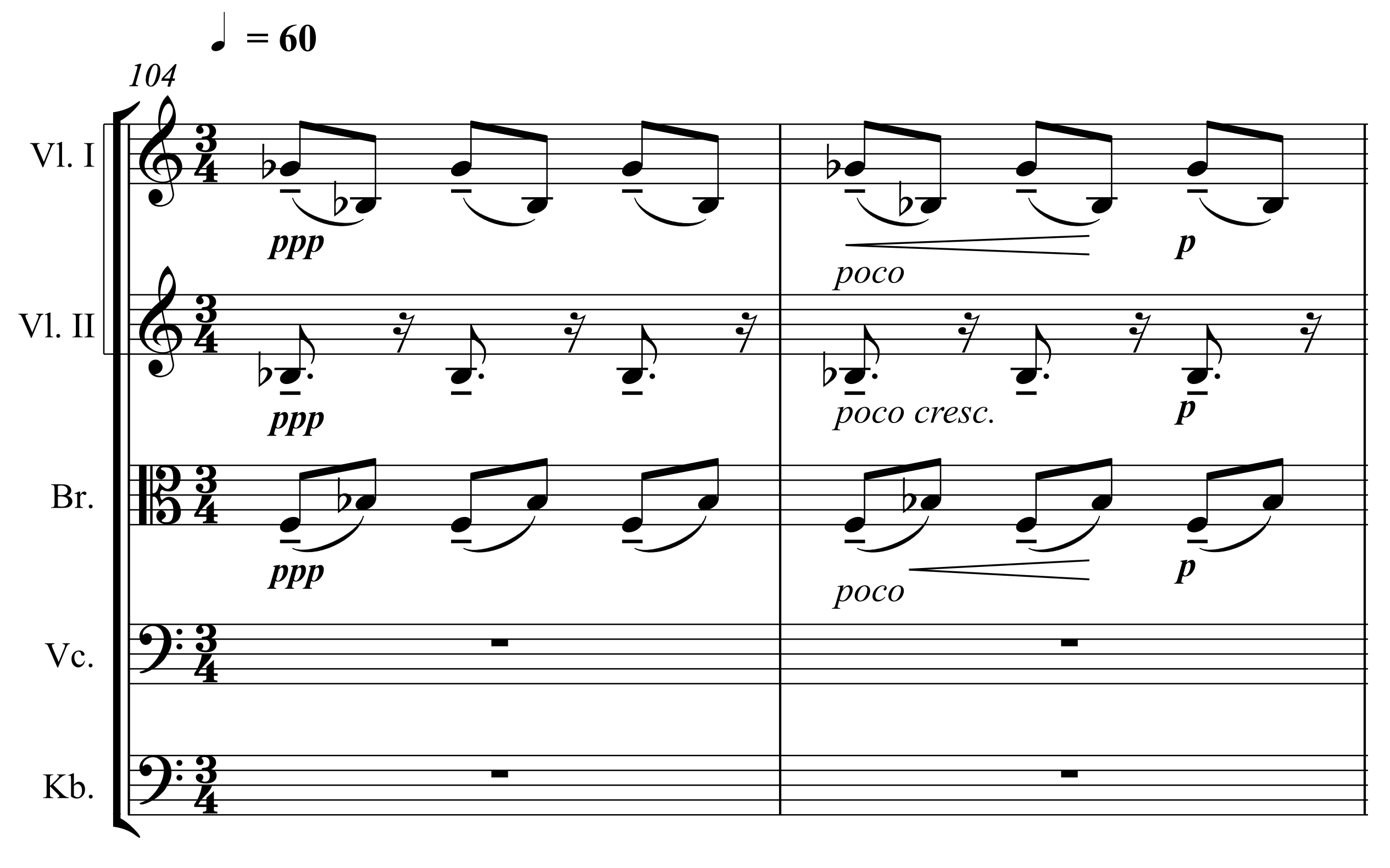
Music example 1: No. 7 “Pas de deux”, bars 104f., strings only, from: Giselher Klebe, Menagerie. Ballett in fünf Bildern op. 31, based on the orchestral score © Bote & Bock 1958, 57. Transcribed by Patrick Dziurla
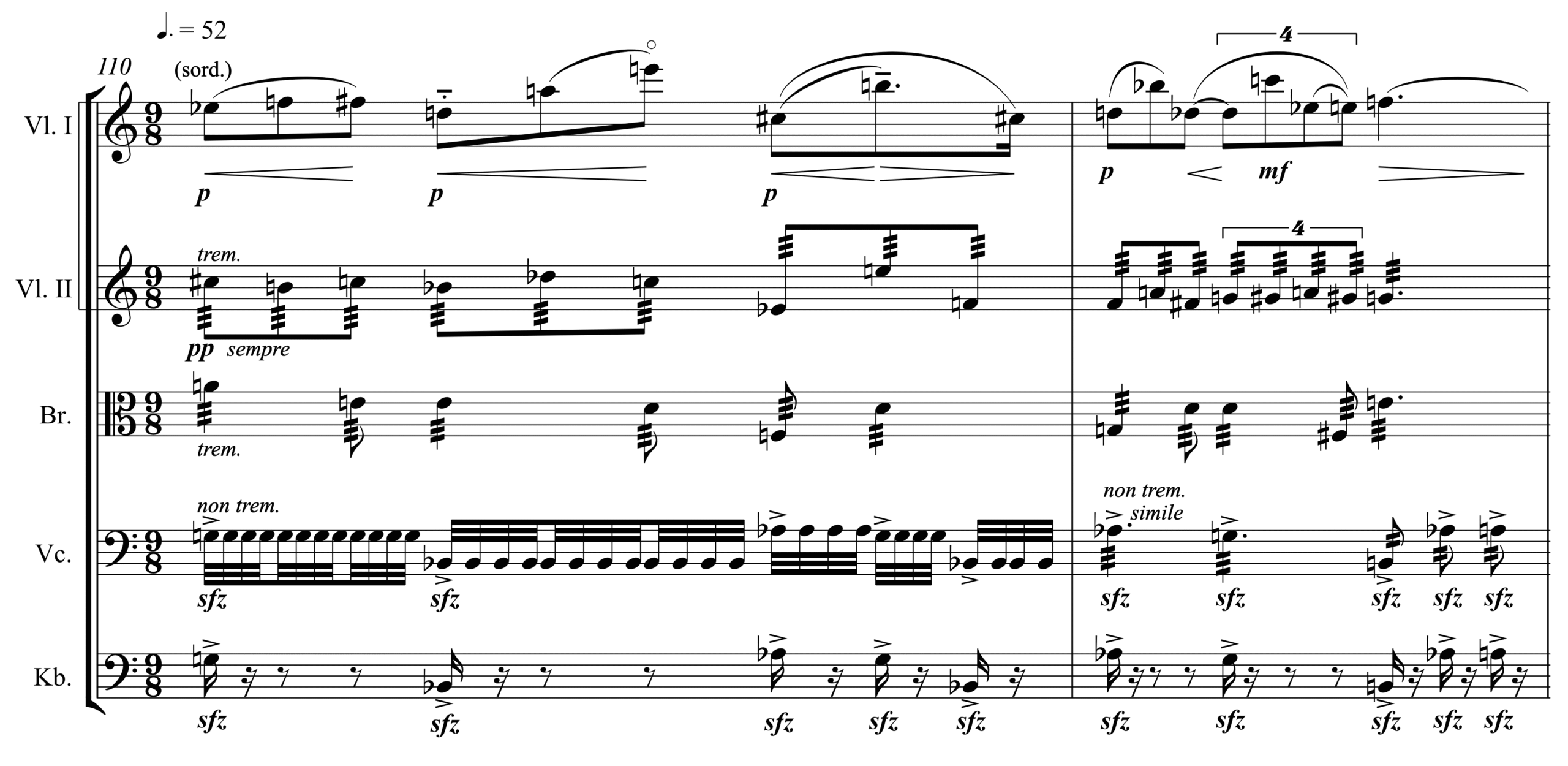
Music example 2: No. 7 “Pas de deux”, bars 110f., strings only, from: Giselher Klebe, Menagerie. Ballett in fünf Bildern op. 31, based on the orchestral score © Bote & Bock 1958, 59. Transcribed by Patrick Dziurla
Movement and Music without Plot—Kontraste
Zimmermann’s ballet Kontraste aims less at a theatrical statement than at theatrical expression. The piece was created on the basis of Zimmermann’s incidental music for Das Grün und das Gelb (The Green and the Yellow), an abstract puppet theater piece by the Swiss puppeteer Fred Schneckenburger.38 The composer had initially composed this music for piano in 1952, based on an early version of his piano cycle Exerzitien, and recorded it himself on tape for Schneckenburger’s theater performances.39 Zimmermann was very excited40 about the project and its scenic realization, and shortly afterwards he asked the Nordwestdeutscher Rundfunk (NWDR) to perform the puppet theater as part of the concert series “das neue werk” in Hamburg.41 For this occasion, he changed the piano version into an orchestral version42 from which, with a further revision in the course of 1953, the ballet Kontraste finally emerged.43
The motivation newly conceive incidental music for the ballet was, apart from the prospect of an immediate concert performance at Bayerischer Rundfunk,44 apparently Zimmermann’s fascination with the scenic idea behind Schneckenburger’s plot of Das Grün und das Gelb and its special realization on the puppet stage. In August 1953, he wrote Schneckenburger a long letter describing in detail his thoughts on the change of concept,45 which he subsequently elaborated on in various other letters and comments on the work.46 Zimmermann perceived the actual core of Schneckenburger’s plot to be a play based on contrasts using the “Urelemente” (primal elements) of the music-theatrical stage, “Musik, Bewegung und Farbe” (music, movement, and color).47 These primal elements could be grasped absolutely by abandoning a plot, which in turn made a plotless ballet possible in a special way.48
Looking at the puppet play makes it clear what the composer means by this, and at the same time underlines the importance of Schneckenburger’s scenic realization for the conception of Kontraste, and here in particular of the two colors that act as protagonists there.49 In the puppet play, the green of the meadow falls in love with the yellow of the sun, they caress each other, while the sun and the meadow are left colorless. After a revolt of people and animals, both colors return to the meadow and the sun.50 While the other figures were embodied with Schneckenburger’s typically abstract rod puppets, the meadow and the sun initially appeared on stage as a green veil and a sun disk.51 As the colors emerged from their objectivity, the actors changed: the now absolute colors were represented by yellow and green gloved hands that pantomimically clasped each other to the sounding music.52 If one takes a closer look at this play of movement, it becomes clear what must have impressed the composer about it. The hands caressing each other can be perceived as abstract three-dimensional bodies of color which constantly change their appearance through movement to the music.53 The association with an absolute color dancing in space is indeed not too far-fetched. While photos of the original performance already illustrate this possibility of reception,54 the special performative impression of the hand play was recently impressively reproduced on the basis of a scenic reconstruction of the piece. On the occasion of Zimmermann’s hundredth birthday, the piece was staged for the first time in a long time at the Villa Massimo in Rome at the suggestion of Dörte Schmidt. It was performed by the puppet opera Marionettenoper im Säulensaal of the Heidelberg University under the direction of Joachim Steinheuer and underscored the enormous representational potential of the hands as abstract bodies of color.55
By reviewing the scenic arrangement of Das Grün und das Gelb, one of Zimmermann’s sources of inspiration for the conception of Kontraste can thus be defined in a more differentiated way. The concept of abstract color forms acting in space is thus likely derived not only from abstract painting—cited by Zimmermann himself as the source of ideas, here specifically in the works of Joan Miró56—but also to a large extent from Schneckenburger’s scenography of Das Grün und das Gelb.57 The special performance of hand-playing to represent abstract colors acting independently in space in Schneckenburger’s piece must have made Zimmermann aware of the enormous possibilities offered by a combination of absolute color and kinetics in theatrical and dance-theatrical contexts.58
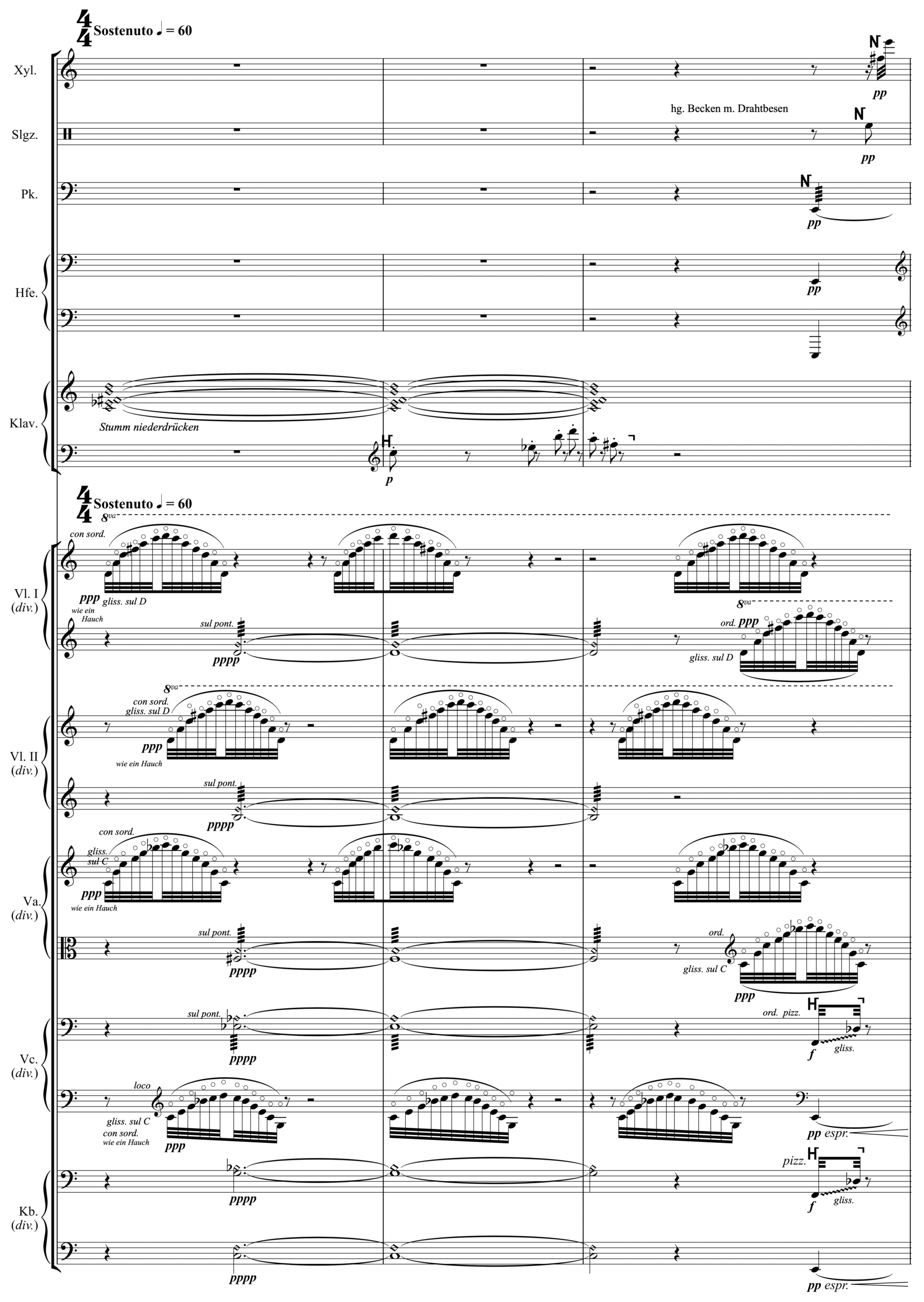
Music example 3: “Phantasmagorie. Blanc—Pas de deux,” bars 1-3, from: Bernd Alois Zimmermann, Kontraste. Musik zu einem imaginären Ballett nach einer Idee von Fred Schneckenburger, based on the orchestral score © Schott 1977, 20. Transcribed by Patrick Dziurla
Zimmermann also transfers this basic idea of color and movement as a central characteristic into the music, which he calls an “imaginary ballet” in the subtitle, but at the same time allows the piece a scenic realization on stage.59 Although Zimmermann links the six movements of the piece with a semantic idea of a mirror of life abstracted from the puppet play plot and with references to color,60 he emphasizes several times that no representation of colors or their synesthetic characters is intended.61 Rather, the focus is on the attempt to musically explore various “Farbklangmöglichkeiten” (color sound possibilities) beyond specific motifs or themes by creating contrasts and “to dissect the color sound ‘spatially,’ as it were” (“den Farbklang gewissermaßen ‘räumlich’ zu zerlegen”).62 In a scenic realization, he considers it also as central that none of the arts involved merely serve to support or interpret the others, but are each equal in their artistic significance.63
What Zimmermann means by a spatial dissection of color sound can be illustrated most vividly in the “Phantasmagoria (Blanc)” at the center of the piece.64 Here Zimmermann creates music that evokes both spatial movement and permanent changes in timbre through various sound events that are repeatedly combined with different timbres.65 This becomes clear right at the beginning. Harmonic figures of violin 1.1, violin 2.2 and viola 1 suggest movement through their ascending and descending melody, but are also set against each other in voice groups of violin and viola or violin and violoncello. This creates the impression of a continuous, wave-like, but spatially distributed movement, in which the different timbres of the instruments create different sound facets despite playing the same notes. The movement character of the figures is deliberately intensified by the fact that the harmonics are contrasted with horizontal sounds in the double bass and the muted piano, thus creating a tonal contrast between movement and stillness. The tremolos of violin 1.2, violin 2.2 and viola 2 again seem to be a combination of movement and standstill, by linking the soundscape and short note values. This idea is transformed in later bars by the use of alternating notes instead of pure repetitions (e.g., bar 7).
This presentation of various movement phenomena is combined with elements that can be heard as yet another form of movement, such as the ascending and descending melody line fragmented by rests in the left hand of the piano (bars 2f.) or the glissando lines in the low strings (bar 3; see figure 3). Sound transformation occurs again here when the melody, which is only brief, is heard again in the harp (bars 4-6), or when the glissando effect returns later in other instruments such as the harp or the kettledrum (bars 7, 11). Another element of movement is dynamics, which can be perceived as spatial movement. Here, for example, we can refer to dynamic progressions which, by becoming louder and quieter, evoke a spatial arrival or, in the opposite direction, a spatial departure.66 The fact that such dynamic progressions are not linked to certain instruments or to a specific motif again translates the aspect of the changing color movement into sound (figure 4). Zimmermann thus writes music in which the goal is not the visual depiction of a movement, a color, or even the synchronization with a possible dance movement, but rather the audible experience of diverse timbres and manifold tonal movement in space.67
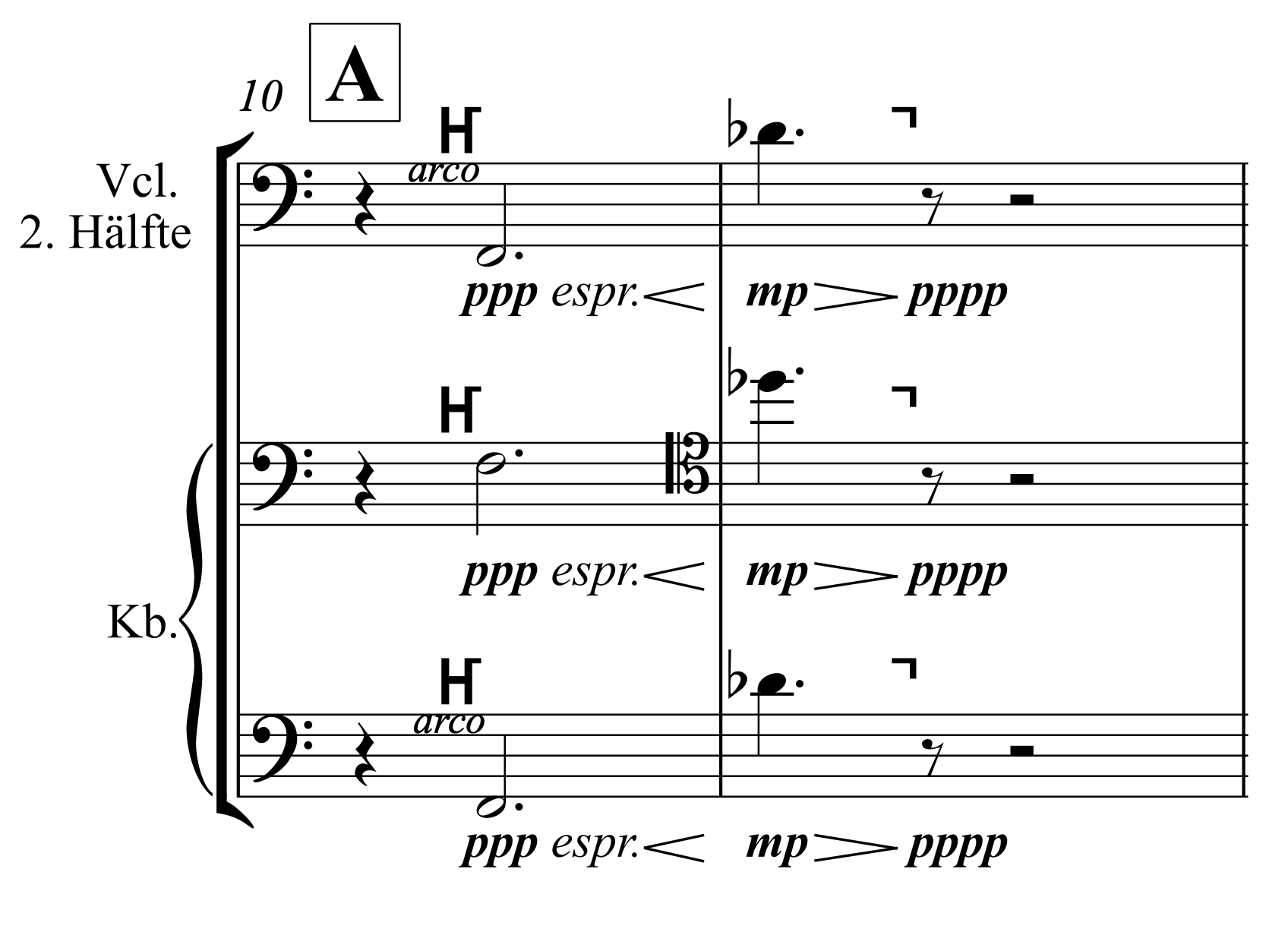
Music example 4: “Phantasmagorie. Blanc—Pas de deux,” bars 10f., only violoncello 2, double bass 1 and 2, from: Bernd Alois Zimmermann, Kontraste. Musik zu einem imaginären Ballett nach einer Idee von Fred Schneckenburger, based on the orchestral score © Schott 1977, 23. Transcribed by Patrick Dziurla
In Peter Roleff’s choreography for the ballet’s premiere on April 24, 1954 at the Stadttheater in Bielefeld, the idea of the colors moving and constantly changing form is also explicitly made central. Although Zimmermann emphasized that the dance-theatrical realization was the choreographer’s responsibility, he had clear ideas about the scenic and costume design, which he had already communicated to Schneckenburger and which he also communicated in a slightly abbreviated and modified form to Herbert Decker, the artistic director of the Bielefeld theater.68 Furthermore, as can be seen from the correspondence with the choreographer and the Bielefeld artistic director, Zimmermann had discussed the overall direction, the stage design and scenic ideas extensively with Peter Roleff in the run-up to the performance. Therefore the choreographer was probably informed both about the genesis of the ballet from the incidental music and about the composer’s conceptual ideas.69 In this respect, it seems legitimate to interpret Roleff’s choreography as a reflection of Zimmermann’s own concept.
Against this backdrop, it is remarkable that Roleff not only takes up the idea of color acting in space, but also the moment of color’s emergence from the representational, which had been determining in Das Grün und das Gelb. Based on reviews and photographic material from the premiere, it can be reconstructed that Roleff had planned dancers in unitards for the frame parts of the piece, who acted in combination with colored form boards—circles, triangles, lines, or intertwined elements.70 In the interior movements, on the other hand, the dancers appeared without color boards, only in colored unitards with small geometric headdresses.71
Relating this realization to Zimmermann’s conceptual idea and thus also to Schneckenburger’s puppet show, it becomes apparent that Roleff placed the emphasis in the frame parts (analogous to the puppet show) on the geometric color form moving in space.72 In the interior parts, however, Roleff blended—like Zimmermann in his costume suggestions—Schneckenburger’s idea of the colored gloved hand with the colored unitard onto the entire body of the dancers. In doing so, he transferred the scenic idea of the abstract three-dimensional body of color to the ballet stage, which can be derived from Schneckenburger’s performative hand play and which continuously changes its appearance through dance movement. Roleff’s choreographic realization of the piece thus kept the central concept of Kontraste visually present for the audience and thus drew attention beyond the visual part of the network of interrelations between music and choreography to the compositional handling of timbre and space.
Conclusion
Based on the two examples given, it becomes clear that different models of movement design can be found in ballets of the post-war period. The Klebe scene presented focused on the visual representation of a scenic movement in the music. This temporary synchronization of audible and visible movement served to allow movement to emerge as movement from the dance context in the network of connections between music and choreography and thus to become recognizable as a metaphor for the constellation of characters and the dramatic situation. Despite the use of new music, the use of audible movement is thus shown here as an artificial interaction of the traditional elements of dance theater serving the dramatic statement.
The example from Kontraste, on the other hand, illustrates the musical reflection on fundamental parameters of body and movement, which is particularly possible due to the use of new music. Zimmermann does not focus on the musical representation of movement, but on its expression in a kinesthetically intended score.73 The artistic idea here is to create different kinds of movement qualities with the aim of audible color movements. If the abstract visual impression of the colorfully gloved hands from Schneckenburger’s puppet piece provided the inspiration for the musical conception, Peter Roleff also took this up in the choreography. In contrast to Klebe and Gsovsky, the focus in Kontraste is not on the unification of the arts at the service of a plot-bound statement, but on the artistically individual implementation of the same theatrical idea in each case, which draws attention to the underlying idea of color movements in space in the interaction of visual and audible events.
With such different models in the merging of new music and dance, the post-war ballet repertoire thus provides starting points both for the reinvention of the narrative ballet, as well as for the numerous experimental formats of later years.
-
Cf. in particular Patricia Stöckemann, “Glücklich ist, wer vergisst. Die ersten Nachkriegsjahre in den westlichen Besatzungszonen,” in Hedwig Müller, Ralf Stabel, and Patricia Stöckemann, Krokodil im Schwanensee. Tanz in Deutschland seit 1945, ed. Akademie der Künste Berlin (Frankfurt am Main: Anabas, 2003), 9-26 and Patricia Stöckemann, “Wir sind wieder wer. Neuorientierung am Ballett—die 50er Jahre in der Bundesrepublik Deutschland,” in Müller, Stabel, and Stöckemann, Krokodil im Schwanensee, 47-84.↩︎
-
Stöckemann, “Wir sind wieder wer,” 72; here also Kurt Peters, “Die Stunde Null wurde verpaßt. Ein Gespräch mit Hartmut Regitz,” in Tanz in Deutschland. Ballett seit 1945. Eine Situationsbeschreibung, ed. Hartmut Regitz (Berlin: Quadriga, 1984), 54-9, 55; the wide-ranging influence of the Allied cultural policy is also pointed out by Gunhild Oberzaucher-Schüller, “Erdbeermund spricht Ballett. Tatjana Gsovskys Choreographie ‘Der Idiot’ zu Musik von Hans Werner Henze,” in Experimentelles Musik- und Tanztheater, ed. Frieder Reininghaus and Katja Schneider in collaboration with Sabine Sanio (Laaber: Laaber, 2004) (Handbuch der Musik im 20. Jahrhundert, vol. 7), 133-6, 135; pointing to the general importance of ballet in the cultural Cold War, using the example of American and Soviet exchange tours, for example: Cadra Peterson McDaniel, American-Soviet Cultural Diplomacy (Lanham: Lexington Books, 2015), 180.↩︎
-
Oberzaucher-Schüller, “Erdbeermund spricht Ballett,” 134f.↩︎
-
Stöckemann, “Glücklich ist, wer vergisst,” 12, 19; Peters, “Die Stunde Null wurde verpaßt,” 54.↩︎
-
Stöckemann, “Wir sind wieder wer,” 56.↩︎
-
Stephanie Schroedter, “Neue Klangräume für neue Bewegungsformen und Bewegungsformate,” in Neue Musik in Bewegung. Musik- und Tanztheater heute, ed. Jörn Peter Hiekel (Mainz: Schott, 2011), 134-58, 135f.; Stöckemann, “Wir sind wieder wer,” 66f.↩︎
-
Jörn Peter Hiekel, Bernd Alois Zimmermann und seine Zeit (Lilienthal: Laaber-Verlag, 2019), 169; Stephanie Schroedter, “Musik als eine Kartographie des Tanzes. Anmerkungen zum Verhältnis von (Musik-)Partitur und Choreographie,” in Notationen und choreographisches Denken, ed. Gabriele Brandstetter, Franck Hofmann, and Kirsten Maar (Freiburg i. Br.: Rombach, 2010) (Rombach Wissenschaften. Reihe Scenae, vol. 13), 67-86, 73.↩︎
-
Cf. e.g. Michael Heuermann, Tatjana. Leben und Werk der Choreographin und Pädagogin Tatjana Gsovsky, München 2007; Max W. Busch, Tatjana Gsovsky. Choreographin und Tanzpädagogin, Berlin 2005; Michael Heuermann, Tatjana Gsovsky und das ‘Dramatische Ballett.’ Der ‘Berliner Stil’ zwischen Der Idiot und Tristan (phil. dissertation, Universität Bremen, 2001), accessed 18 August 2021, http://nbn-resolving.de/urn:nbn:de:gbv:46-diss000001977.↩︎
-
Cf. e.g. the more elaborate contributions on Zimmermann’s ballet work by Jörn Peter Hiekel, Bernd Alois Zimmermann und seine Zeit (Lilienthal: Laaber, 2019); Dörte Schmidt, “‘C’est ma façon de faire du Pop Art.’ Zimmermann et le ballet dans les années 1960,” in Regards croisés sur Bernd Alois Zimmermann. Actes du colloque de Strasbourg 2010, ed. Pierre Michel, Heribert Henrich, and Phillipe Albèra (Genf: Éditions Contrechamps, 2012), 143-57; Steffen A. Schmidt, Musik der Schwerkraft. Die Beziehung von Musik und Ballett in Deutschland nach 1945, dargestellt am Werk Bernd Alois Zimmermanns (Berlin: Kadmos, 2012); Silke Hilger, “Annäherungen an Bernd Alois Zimmermanns Ballettkompositionen,” in Feedback Papers 41 (1996): 38-50; Erik Fischer, “Bernd Alois Zimmermann und das Tanztheater seiner Zeit. Versuch einer ersten Rekonstruktion,” in Zwischen den Generationen. Bericht über das Bernd-Alois-Zimmermann-Symposion Köln 1987, ed. Klaus Wolfgang Niemöller and Wulf Konold (Regensburg: Bosse, 1989) (Kölner Beiträge zur Musikforschung, vol. 155), 165-203.↩︎
-
Heuermann, Tatjana Gsovsky, 167; Giselher Klebe, “Zu meiner Musik,” in Programmheft Apollon musagète, Die Letzte Blume, Menagerie, Städtische Oper Berlin [Berlin 1958], printed in Michael Rentzsch, Giselher Klebe. Werkverzeichnis 1947-1995, ed. Stiftung Archiv der Akademie der Künste, Berlin (Kassel: Bärenreiter, 1997), 75f.; in parts printed in Busch, Tatjana Gsovsky, 156.↩︎
-
Although Gsovsky states in the “Almanach der Berliner Festwochen” that the piece was based on “Frank Wedekinds Bühnenstück ‘Lulu’” (Frank Wedekind’s play ‘Lulu’, 91), the source material was probably not the “Tragödie in fünf Aufzügen” (Tragedy in Five Acts), which the author published in 1913 and which was a combination of various acts taken from Erdgeist and Die Büchse der Pandora. The actual source might be the other version published also in 1913, in which both aforementioned tragedies were included in their entirety. This can be deduced from the fact that Gsovsky took, among other things, act III from Erdgeist, which does not exist in the stage play Lulu, as the basis for the second ballet scene. Generally, the two tragedies are frequently summarized, but by no means correctly addressed under the title Lulu. Thus might also be true for Gsovsky’s case; on this Ariane Martin, “Pierrot als Femme fatale? Zu den Fassungen und Deutungen von Frank Wedekinds ‘Lulu’-Dramenkomplex in kulturwissenschaftlicher Perspektive,” in Musil-Forum. Studien zur Literatur der klassischen Moderne 27 (2001/2002): 119-36, 122. On the history of the genesis, revision, and publication of Erdgeist and Die Büchse der Pandora cf. esp. Frank Wedekind Werke. Kritische Studienausgabe, vol. 3/2: “Kommentar,” ed. Hartmut Vinçon (Darmstadt: Häusser, 1996), 833-7, 876, 878 and Katrin Hafemann, Schamlose Tänze. Bewegungs-Szenen in Frank Wedekinds ‘Lulu’-Doppeltragödie und ‘Mine-Haha oder Über die körperliche Erziehung der jungen Mädchen’ (Würzburg: Königshausen & Neumann, 2010), 99f.; Tatjana Gsovsky, “Wedekind getanzt,” in Berliner Festwochen vom 21. September bis 2. Oktober 1958. Almanach. Offizielles Programm [Berlin 1958], 91.↩︎
-
Heuermann, Tatjana Gsovsky, 137.↩︎
-
Thus the title already refers to Gsovsky’s central choreographic idea, cf. ibid., 167, 204.↩︎
-
Ibid., 135f., 138.↩︎
-
On the conception of the scene in Wedekind’s version cf. Hafemann, Schamlose Tänze, 115.↩︎
-
Ibid., 115f.; on the connection between dance and erotic presentation in Wedekind’s work ibid. 108f., 119; and Ortrud Gutjahr, “Lulu als Prinzip. Verführte und Verführerin in der Literatur um 1900,” in Lulu, Lilith, Mona Lisa … Frauenbilder der Jahrhundertwende, ed. Irmgard Roebling (Pfaffenweiler: Centaurus-Verlagsgesellschaft, 1989), 45-76, 63.↩︎
-
Hafemann, Schamlose Tänze, 119.↩︎
-
Stage direction: “Auf das ertönende Klingelzeichen hin eilt Lulu wieder ab. Die Aufmerksamkeit soll jetzt ganz auf Dr. Schön und seine Braut gelenkt sein” (At the sound of the bell, Lulu hurries off again. The attention should now be completely focused on Dr Schön and his bride), as cited in: Giselher Klebe, Menagerie. Ballett op. 31, Bote & Bock, Berlin 1958 [borrowed material], Akademie der Künste, Berlin (D-Bda), Giselher-Klebe-Archiv 211, 47.↩︎
-
Cf. stage directions in Klebe, Menagerie [orchestral score], 62f.↩︎
-
Published in Busch, Tatjana Gsovsky, 156; confirmed by a production photo showing Willy Saeger with Judith Dornys and Rudolf Holz, Berlin 1958, ibid., 159.↩︎
-
Cf. the respective stage directions in Klebe, Menagerie [orchestral score], 55.↩︎
-
Frank Wedekind, “Erdgeist. Tragödie in vier Aufzügen (1913),” in Frank Wedekind Werke. Kritische Studienausgabe, vol. 3/1, ed. Hartmut Vinçon (Darmstadt: Häusser, 1996), 401-76, 455.↩︎
-
Heuermann, Tatjana Gsovsky, 18, 124.↩︎
-
Interview with Klaus Geitel, in Ein Leben für den Tanz. Die Wanderungen der Tatjana Gsovsky, film by Christine Schaefers, WDR 1985, 43ʹ18ʹʹ-43ʹ38ʹʹ.↩︎
-
This is characteristic of Gsovsky’s choreographies, cf. Heuermann, Tatjana Gsovsky, 120, 125f., 132, 137.↩︎
-
Ibid., 204.↩︎
-
On the referential aspect of scenic movement on the inner processes of stage characters, cf. Stephanie Schroedter, “Audio-visuellen Bewegungen auf der Spur. Zum Konzept eines klangperformativen Spurenlegens und Spurenlesens,” in Klänge in Bewegung. Spurensuchen in Choreografie und Performance, ed. Sabine Karoß and Stephanie Schroedter (Bielefeld: transcript, 2017), 25-44, 26.↩︎
-
Cf. on the balance of power and its sadomasochistic implications, amongst others Hafemann, Schamlose Tänze, 111f.; Gutjahr, “Lulu als Prinzip,” 63f.; Mildner even calls it a “power struggle” between the two protagonists, whose relationship is defined by desire, humiliation, hate but also love; Susanne Mildner, Konstruktionen der Femme fatale. Die Lulu-Figur bei Wedekind und Pabst (Frankfurt am Main: Peter Lang 2007), 21f.↩︎
-
On the dramaturgical function of dancing in this scene and the effects on the drawing of characters in Wedekind’s work cf. Hafemann, Schamlose Tänze, 115-25.↩︎
-
Enkelmann himself emphasizes that snapshots during performances were usually impossible to realize due to the lighting conditions. In his studio shots, he says he only worked against a white background and with deliberate lighting to set the scene. For him, it was central to “capture the mood as well as the character of the dance” and “the magic of the dance atmosphere” (die “Stimmung sowie den Charakter des Tanzes” und “den Zauber der tänzerischen Atmosphäre zu treffen”); Siegfried Enkelmann, [no title], in S. Enkelmann. Ein halbes Jahrhundert Tanz- und Ballett-Fotografie. Gedächtnisausstellung. Theatermuseum München. April bis Juni 1978 und Theater Gütersloh November 1978 bis Januar 1979 (München: Dt. Theatermuseum, 1979), [1].↩︎
-
The photos have been preserved in the estates of Siegfried Enkelmann in the Deutsche Tanzarchiv, Cologne, and of Tatjana Gsovsky and Gert Reinholm in the Akademie der Künste, Berlin. One of them is published in Busch, Tatjana Gsovsky, 160.↩︎
-
The analysis is based on Klebe, Menagerie [orchestral score].↩︎
-
The bar-counting follows the score, in which the individual numbers are consecutively counted scene by scene.↩︎
-
Klebe, Menagerie [orchestral score], 55.↩︎
-
Cf. on such correlation effects Stephanie Jordan, “Choreomusical Conversations. Facing a Double Challenge,” in Dance Research Journal 43/1 (2011): 43-64, 50.↩︎
-
I am grateful to Rainer Nonnenmann and Christoph Flamm for these references.↩︎
-
Remi Hess, Der Walzer. Geschichte eines Skandals (Hamburg: Europäische Verlagsanstalt, 1996), 275f.↩︎
-
Cf. on this piece Dörte Schmidt, “‘Das Grün der Wiese hat sich in das Gelb der Sonne verliebt. Was geschieht jetzt?’ Fred Schneckenburger und Bernd Alois Zimmermann machen abstraktes Puppentheater mit Musik,” in “Man müßte nach Rom gehen.” Bernd Alois Zimmermann und Italien, ed. Sabine Ehrmann-Herfort, Adrian Kuhl, Dörte Schmidt, and Matthias Pasdzierny (Kassel: Bärenreiter, 2020) (Analecta musicologica, vol. 55), 70-94; Hana Ribi, Fred Schneckenburgers Puppencabaret (Prag: Národní muzeum, 1999), 73-5.↩︎
-
See for this Heribert Henrich, Bernd Alois Zimmermann Werkverzeichnis. Verzeichnis der musikalischen Werke von Bernd Alois Zimmermann und ihrer Quellen. Erstellt unter Verwendung von Vorarbeiten von Klaus Ebbeke (Mainz: Schott Music, 2013), 747f., 753 (ibid. the list with adaptations from Exerzitien); St. A. Schmidt, Musik der Schwerkraft, 155f.; Klaus Ebbeke, “Kontraste. Musik zu einem imaginären Ballett nach einer Idee von Fred Schneckenburger (1953),” in Klaus Ebbeke, Zeitschichtung. Gesammelte Aufsätze zum Werk von Bernd Alois Zimmermann, ed. Heribert Henrich (Mainz: Schott Music, 1998), 136f., 136; Fischer, “Bernd Alois Zimmermann und das Tanztheater,” 184-9; Wulf Konold, Bernd Alois Zimmermann. Der Komponist und sein Werk (Köln: DuMont, 1986), 86; on the recovered audio tapes cf. D. Schmidt, “‘Das Grün der Wiese hat sich in das Gelb der Sonne verliebt,’” 71.↩︎
-
Letter to Jacques Wildberger from July 19, 1957, printed in Henrich, Bernd Alois Zimmermann Werkverzeichnis, 747.↩︎
-
Henrich, Bernd Alois Zimmermann Werkverzeichnis, 748; Bernd Alois Zimmermann (1918-1970). Dokumente zu Leben und Werk, ed. Klaus Ebbeke (Berlin: Akademie der Künste, 1989) (Akademie-Katalog, no. 152), 52.↩︎
-
Ebbeke, “Kontraste,” 136; on the compository changes cf. Henrich, Bernd Alois Zimmermann Werkverzeichnis, 753f.↩︎
-
The orchestral piece Suite aus Das Gelb und das Grün is also based on the orchestral score.↩︎
-
Henrich, Bernd Alois Zimmermann Werkverzeichnis, 155.↩︎
-
Letter to Fred Schneckenburger from August 2, 1953, printed in ibid., 150.↩︎
-
Cf. e.g. commentaries on the works from September 28, 1954 and from September 10, 1957 as well as the letters to Bernhard Conz from September 2, 1953 and to Herbert Decker from December 2, 1953, each printed in ibid., 151-4.↩︎
-
Letter to Bernhard Conz, Städtische Bühnen Bielefeld, from September 2, 1953, printed in ibid., 151. The connection between colors and ballet in this context are not new, of course. Cf. Fischer, “Bernd Alois Zimmermann und das Tanztheater,” 190; St. A. Schmidt, Musik der Schwerkraft, 154f., 162f.; but Schmidt points out fundamental differences, ibid. 164.↩︎
-
Letter to Fred Schneckenburger from August 2, 1953; comments on the work for the radio broadcast on September 10, 1957, in letter to Otto Tomek, Westdeutscher Rundfunk, from August 28, 1957, each printed in Henrich, Bernd Alois Zimmermann Werkverzeichnis, 150, 154.↩︎
-
Comments on the work for the radio broadcast on September 10, 1957, printed in ibid., 154.↩︎
-
Letter to Fred Schneckenburger from August 2, 1953, printed in ibid., 150.↩︎
-
Ribi, Fred Schneckenburgers Puppencabaret [1999], 74f.↩︎
-
Ibid., 74; on possible references to this depiction cf. D. Schmidt, “‘Das Grün der Wiese hat sich in das Gelb der Sonne verliebt,’” 82; Hana Ribi, “Fred Schneckenburgers Puppencabaret,” in Sammeln heisst forschen. Lasst die Puppen tanzen, ed. Museum für Gestaltung Zürich (Zürich: Museum für Gestaltung Zürich, 2017), 116-8, 118.↩︎
-
Contemporary reviews already emphasize abstraction as a central characteristic of the scene, cf. St. A. Schmidt, Musik der Schwerkraft, 160.↩︎
-
Cf. the photos by Michael Wolgensinger in Ribi, Fred Schneckenburgers Puppencabaret [1999], 73.↩︎
-
On the reconstruction cf. Joachim Steinheuer and Dörte Schmidt, “‘Mit eigenen Ideen ganz ausgefüllt.’ Zur szenischen Rekonstruktion von ‘Das Grün und das Gelb,’” in “Man müßte nach Rom gehen.” Bernd Alois Zimmermann und Italien, ed. Sabine Ehrmann-Herfort, Adrian Kuhl, Dörte Schmidt, and Matthias Pasdzierny (Kassel: Bärenreiter, 2020) (Analecta musicologica, vol. 55), 136-48 (incl. photo series).↩︎
-
Hiekel, Bernd Alois Zimmermann und seine Zeit, 164; Hiekel also points to the role of color in the constellation of geometric bodies in Miró’s paintings ibid. 165; on the enthusiasm of Zimmermann for the painter as well as on further correspondence on Miró cf. ibid. 164-6; cf. also St. A. Schmidt, Musik der Schwerkraft, 161; it is not clear which paintings by Miró Zimmermann might have referred to; he must at least have known Miró’s Personnages et etoiles 1950. The painting was printed on the cover of Schneckenburger’s program for the staging of Das Grün und das Gelb at the NWDR in Hamburg; St. A. Schmidt, Musik der Schwerkraft, 160.↩︎
-
Not so Steffen A. Schmidt, who emphasizes that Zimmermann “did specifically not refer to a certain painting […] or work (like that of Schneckenburger);” ibid., 161 (trans. Stephanie Schöberl): Zimmermann habe “gezielt nicht Bezug auf ein bestimmtes Bild […] oder Werk (wie das Schneckenburgers)” genommen.↩︎
-
Cf. for a broader analysis of the aesthetic, musical and choreographic concept of Kontraste my forthcoming study “Die wollten Ballette schreiben”. Westdeutsches Ballett in den 1950er Jahren als Forum der musikalischen Avantgarde.↩︎
-
On the significance of the imaginary cf. Hiekel, Bernd Alois Zimmermann und seine Zeit, 163, 168-81; Wolfgang Rathert, “‘… Ausdruck einer ganz bestimmten geistigen Situation …’ Zum Kontext von B. A. Zimmermann’s ‘Perspektiven’ (1955/56),” in Bernd Alois Zimmermann, ed. Ulrich Tadday (Munich: Ed. Text + Kritik, 2005) (Musik-Konzepte Sonderband. Neue Folge, vol. 12), 143-60, 147; St. A. Schmidt, Musik der Schwerkraft, 40f., 148, 165-9, 171, 181; Schmidt also accentuates the proximity to the dream in the transition from puppet theater music to ballet, ibid., 157, 169f.↩︎
-
On the interpretation of Kontraste as ballet of ideas cf. Fischer, “Bernd Alois Zimmermann und das Tanztheater,” 189; on the proximity of the semantic idea to the dream theme and its references cf. St. A. Schmidt, Musik der Schwerkraft, 147-9. The semantic reference recedes in the course of further performances of the play, cf. Henrich, Bernd Alois Zimmermann Werkverzeichnis, 156.↩︎
-
Letter to Karl Bauer, Bühnen der Stadt Essen, from October 8, 1954; comments on the work for the radio broadcast on September 10, 1957; letter to Friedrich Berger, Kölner Stadt-Anzeiger, from July 15, 1964, each printed in Henrich, Bernd Alois Zimmermann Werkverzeichnis, 153-5.↩︎
-
Letter to Reinhold Schubert from January 16, 1957, printed in ibid., 153.↩︎
-
Dörte Schmid has pointed out the central importance of Kontraste and the ballet for the development of this esthetic concept in Zimmermann’s thinking, D. Schmidt, “‘C’est ma façon de faire du Pop Art,’” 146-53.; cf. on this concept amoung others also St. A. Schmidt, Musik der Schwerkraft, 95-110, 164-7; Fischer, “Bernd Alois Zimmermann und das Tanztheater,” 183, 185, 190-2.↩︎
-
The analysis is based on the orchestral score: Bernd Alois Zimmermann, Kontraste. Musik zu einem imaginären Ballett nach einer Idee von Fred Schneckenburger für Orchester (1958) (Mainz: Schott 1977) [borrowed material].↩︎
-
Steffen A. Schmidt sees in such a compositional layout the work with a “musically contoured body” (“musikalisch konturierten Körper,” 151), which he pursues by means of his methodology of “KörperHören”; a methodology that enables a reading of music in terms of “corporeal representations” (“korporale Repräsentationen”), St. A. Schmidt, Musik der Schwerkraft, 71; in this context cf. ibid., 59-94, as to Kontraste ibid., 171 and Steffen A. Schmidt, “KörperHören,” in Die Tonkunst 2 (2008): 67-73.↩︎
-
Cf. St. A. Schmidt, Musik der Schwerkraft, 260.↩︎
-
Hiekel is similar in this and points to references to the approaches of Willy Baumeister, Paul Klee, and Joan Miró, Hiekel, Bernd Alois Zimmermann und seine Zeit, 166; the significance of the timbre in Kontraste is also emphasized by St. A. Schmidt, Musik der Schwerkraft, 177, 180, 188 (here also with regard to a connection with movement, 309); Hilger, “Annäherungen an Bernd Alois Zimmermanns Ballettkompositionen,” 40.↩︎
-
Letter to Herbert Decker, Städtische Bühnen Bielefeld, from December 2, 1953, Akademie der Künste, Berlin, Bernd-Alois-Zimmermann-Archiv 1.62.159d.70; cf. for a detailed discussion Adrian Kuhl: “Die wollten Ballette schreiben”. Westdeutsches Ballett in den 1950er Jahren als Forum der musikalischen Avantgarde (forthcomming).↩︎
-
Cf. the letter to Peter Roleff from March 2, 1954 and Herbert Decker from March 4, 1954; in the latter Zimmermann informs the artistic director that he has consulted with Roleff on March 3, 1954 at home and that their scenic ideas are “fast völlig” (almost) identical; Akademie der Künste, Berlin, Bernd-Alois-Zimmermann-Archiv 1.62.159e.17 and 1.62.159e.22. Thus Hiekel’s comment that Zimmermann did not participate in the scenic realization, has to be modified; Hiekel, Bernd Alois Zimmermann und seine Zeit, 168.↩︎
-
Same reference in St. A. Schmidt, Musik der Schwerkraft, 189.↩︎
-
Photos can be find in St. A. Schmidt, Musik der Schwerkraft, 190 and Konold, Bernd Alois Zimmermann, figure 17.↩︎
-
Similarly, Steffen A. Schmidt, though without reference to Schneckenburger’s puppet show, recognizes in the choreography “a play of geometry between form and colour” in which “the bodies […] become the functions of an abstract geometry” (ein “Spiel von Geometrie zwischen Form und Farbe,” bei der “die Körper […] zu Funktionen einer abstrakten Geometrie” werden); ibid., 189.↩︎
-
Similar in ibid., 491f.↩︎