Jeremy Coleman  1
1
How to cite
How to cite
Abstract
Abstract
First performed in Paris, 1911, the “burlesque” ballet Petrushka stands today as a central work of the modernist canon and an unruly assemblage of artistic media that eludes any attempt to define it simply in terms of a single “author” or as a work independent of its original production. In this chapter, I focus on Petrushka’s reputation precisely as a concert work—its various instrumental reductions, transcriptions, performances, and their own reception history—as a lens through which to consider the relationship between music and (choreographic) motion. Through a brief analysis of the 1965 Swedish television film of Stravinsky’s Three Movements from Petrushka performed by Alexis Weissenberg and directed by Åke Falck, I consider Petrushka’s life, and that of the work’s eponymous puppet, beyond the theater, and examine in what ways the extra-musical elements of the original work were either erased or preserved in “purely musical” versions.
First performed in Paris, 1911, the “burlesque” ballet Petrushka stands today as a central work of the modernist canon and an unruly assemblage of artistic media that eludes any attempt to define it simply in terms of a single “author” or as a work independent of its original production. In this chapter, I focus on Petrushka’s reputation precisely as a concert work—its various instrumental reductions, transcriptions, performances, and their own reception history—as a lens through which to consider the relationship between music and (choreographic) motion. Through a brief analysis of the 1965 Swedish television film of Stravinsky’s Three Movements from Petrushka performed by Alexis Weissenberg and directed by Åke Falck, I consider Petrushka’s life, and that of the work’s eponymous puppet, beyond the theater, and examine in what ways the extra-musical elements of the original work were either erased or preserved in “purely musical” versions.
The product of a fraught collaboration between creative artists in dance, music, theater, visual arts, and folkloristics, the “burlesque” ballet Petrushka stands today as a central work of the modernist canon and at the same time an unruly assemblage of artistic media that eludes any straightforward attempt to define it in terms of a single author or as a work independent of its original production (Paris, 1911). There is no reason to suppose that Petrushka’s reception has been any less multifaceted than the circumstances of its origins. Christoph Flamm writes in conclusion to a recent encyclopedia entry on the work: “The broader cultural reception history of Petrushka remains to be discovered.”2 Flamm offers some attractive signposts for future research here: the central notion of the “grotesque” in Petrushka arguably anticipates the use of the term by Vsevolod Meyerhold, and there is a possible connection between the carnival setting of the ballet and Mikhail Bakhtin’s celebrated concept of the “carnivalesque.” Whatever the exact relationship in either of these cases, Petrushka’s role within twentieth-century ideas and culture has been underestimated.
And yet it may be Petrushka’s reputation precisely as a concert work in various versions—its reputation, in other words, as Stravinsky’s—that has been the least explored facet of the ballet and its reception. Given its original form as a multimedia ballet work, the work’s parallel existence as a “purely musical” work for the concert hall,3 or as a suite of “scenes” extracted from it, may offer a productive point of view from which to consider the relations between music, choreography, and the performer’s body. Such a mode of performance, transcription and reception is by no means unique to Petrushka: the three ballet scores Stravinsky produced for Diaghilev’s Ballets Russes between 1909 and 1913 owe their present-day popular and canonical status less to fully staged productions than to concert performances, transcriptions for chamber settings, and audio recordings. It is an aspect of the reception history of the ballets that has been overlooked, most likely because it has been taken for granted as the works’ inevitable fate. In what respects Petrushka is a unique case in this respect will be considered below.
This chapter seeks to probe the phenomenon of Petrushka’s life beyond the theater, in an attempt to think through an aspect of the work by no means limited to its reception history. The chapter begins with an overview of Petrushka’s performance versions and arrangements in dialogue with key moments in the work’s collaborative genesis. There follows a discussion of concepts of translation and media via Adorno and Benjamin. The chapter will close with a discussion of Stravinsky’s Three Movements from Petrushka for piano and in particular the 1965 Swedish television film of the piano work performed by Alexis Weissenberg. Through a close reading of the film in light of Petrushka’s broader critical legacy, this essay considers whether the “purely musical” versions erase or in some sense preserve the theatrical and choreographic elements of the original ballet.
Petrushka in Concert
In his essay on the final scene of Wagner’s Tristan und Isolde, John Deathridge focused on the role of “absolute music,” of purely musical beauty, in relation to the social reality of Isolde’s death and transfiguration. Whereas Catherine Clément had interpreted this moment of musical magnificence as an ideological trait of opera in general, where beautiful music conceals the gendered violence meted out to the lead soprano character, for Deathridge the musically absolute is implicated in the violence it simultaneously attempts to exclude.4 He noted the ease with which Isolde’s so-called Transfiguration can be performed independently as an instrumental concert number, with the soprano vocal line simply omitted, one of the more literal illustrations of a dialectical interplay between the Schopenhauerian metaphysics of instrumental music, on the one hand, and the disquieting message of Isolde’s annihilation, on the other.5 In his discussion of the scene and its reception history, including in Nazi Germany, Deathridge highlights a subtle “contract” or “alliance” between “the extramusical and absolute music.”6
Similarly, in approaching Petrushka, I am not aiming to simply excavate social meaning from a work that has become a modernist classic and a canonical text for music theory, so much as to unravel a kind of pact between Stravinsky’s “autonomous” music and the extramusical contexts in which it first emerged. In the case of Stravinsky’s ballet works, the category of the “extramusical” may include theatrical and choreographic entities from which the music became isolated as a work for the concert hall or as audio recordings. My argument thus chimes with Arved Ashby’s 2010 monograph on sound recording technology as a medium in which “absolute music” was variously challenged and preserved as a normative ideal.7 In focusing on Petrushka, I want to expand the discussion of classical music and modern media by considering not only canonical orchestral works originally intended for the concert hall but also music-theatrical works rendered “absolute music” in some sense of the term and at the same time living on in variously mediated forms.
| Title | Composition | First performance | Publication |
|---|---|---|---|
| Petrushka, scènes burlesques en quatre tableaux [burlesque in four scenes] |
Begun in Clarens (Switzerland), August-September 1910, finished in Rome, 26th May 1911 Revision: |
Original ballet: Théâtre du Châtelet, Paris, 13th June 1911 |
Berlin, Édition Russe de Musique (hereafter ERM), 1912 (score and parts), reissued by Boosey & Hawkes, 1947 Revision: London, |
| Petrushka, reduction for piano (four hands) | Rome, May 1911 | n/a | Berlin, ERM, 1912, rev. 1913, rev. 1947 version published by Boosey & Hawkes, 1948 |
| Trois Mouvements de Pétrouchka [Three Movements from Petrushka], transcription for solo piano |
Anglet (France), August-September 1921 |
Paris, 26th December 1922, performed by Jean Wiener | Paris, ERM, 1922; London, Boosey & Hawkes, 1947 |
| Danse Russe, transcription for violin and piano by the composer and Samuel Dushkin |
Voreppe (France), 17th Apr. 1932 |
Funkhaus, Berlin, 28th Oct. 1932, performed by Dushkin and Stravinsky |
Paris, ERM, 1933 |
Table 1 A Catalogue of Petrushkas8
Table 1 summarizes catalogue information about Petrushka and its authentic versions, namely the three reductions or transcriptions produced by the composer.
The Three Movements from Petrushka for solo piano and the Danse Russe for violin and piano were evidently conceived as recital showpieces, whereas the four-hand reduction probably had the more utilitarian function as a short score for rehearsals with the dancers. Table 1 does not list the concert suite of Petrushka, since Stravinsky never published it as a distinct version of the work. However, when Petrushka received its first performance in Russia in early 1913, for instance, it was in the form of concert excerpts: the “Danse russe” at the close of the first tableau, the second tableau (“Chez Pétrouchka”), and the fourth and final tableau (“La semaine grasse”) with a recomposed ending.9 It may be noted that the ad hoc concert suite consisted of the same selection of numbers that Stravinsky would use a decade later as the basis of his Three Movements from Petrushka for piano.
This emphasis on concert performance applies to all three of Stravinsky’s celebrated ballet works written between 1909 and 1913—The Firebird, Petrushka, and The Rite of Spring—and represents nothing less than an ideological rebranding of the works prompted by the composer and his attempt in various autobiographical accounts to downplay the contribution of others in the works’ conception and genesis. What sets Petrushka apart in this respect is the peculiar musical allegory embedded in the work from the very start. As the story goes, in September 1910 Stravinsky conceived of a “concert piece” for orchestra (he used the German term Konzertstück) “in which the piano would play the most important part.”10 For all that the factual accuracy of Stravinsky’s account has been called into question, his autobiographical writings are nonetheless valuable in that his account of Petrushka reflects something of the social dynamic of the original idea. For example, the account of Petrushka’s musical conception in Chroniques de ma vie (published first in French in 1935, and then in English translation in 1936) is often quoted but to my knowledge has yet to be analyzed with reference to the work’s broader critical history:
In composing the music, I had in my mind a distinct picture of a puppet, suddenly endowed with life, exasperating the patience of the orchestra with diabolical cascades of arpeggi. The orchestra in turn retaliates with menacing trumpet-blasts. The outcome is a terrific noise which reaches its climax and ends in the sorrowful and querulous collapse of the poor puppet.11
And in a similar account seven years prior, Stravinsky was quoted in an interview:
In my initial conception, I saw a man in evening dress, wearing his hair long: the musician or the poet of Romantic tradition. He sat himself at the piano and rolled incongruous objects on the keyboard, while the orchestra burst out with vehement protests, with sonic fist-punches.12
A complete account of Petrushka’s early genesis will probably always remain elusive; however, it seems that Stravinsky’s original idea, a grotesque parody of the Romantic concert pianist, was already bound up with the idea of social violence that would be the template, so to speak, for the character of the puppet Petrushka. It may also be noted that the belligerent exchanges between piano and orchestra remained an important feature of the final work.
Christoph Flamm has identified the process of “turning Petrushka, the active principle of aggression, into Pierrot, the passive principle of suffering” as “the result of Diaghilev’s intervention and, above all, Benois’s elaboration.”13 The observation bears further interpretation: the nature of the collaborative process behind Petrushka (namely Stravinsky’s working relationship with Diaghilev, Benois, Fokine, Nijinsky, Karsavina, and so on) mirrors Petrushka’s own character and narrative trajectory. The grotesque, anarchic figure of the Romantic pianist is tempered—symbolically castrated, in psychoanalytic terms—at the moment he comes to be identified with the commedia dell’arte puppet as a figure of tragic suffering. The early compositional history of the ballet thus prefigures a dynamic of social violence and its suppression, providing a critical frame not only for the ballet work itself but for the concert interpretations of Petrushka in which the piano soloist is once again foregrounded.
Translation as Survival
Jonathan Dunsby noted the “menacing immortality” of the clown archetype in Schoenberg’s Pierrot lunaire (first performed in 1912) as well as in Petrushka, two works of music theater almost exactly contemporaneous and in many ways comparable: “it is as if the Pierrot into whom [Schoenberg] breathed life has gone on to shape his own history, to frighten us into believing that he emerged from nowhere, has no ancestors, no attachments and, most provocatively, cannot die.”14 Dunsby implies a metonymic identification between Schoenberg’s titular protagonist and the work as a whole, and this suggestion of a spectral haunting takes on further significance in the case of Petrushka in light of the various concert versions in which the work has been disseminated. Petrushka is killed in the final duel with his romantic rival, the “Moor,” but his ghost returns at the last moment, thumbing his nose at the Old Magician who brought him to life,15 just as the work recedes from the “presence” of the fully staged ballet production and takes on another life in the concert hall.
Already in his Philosophie der neuen Musik (1949), Theodor Adorno observed parallels and divergences between the two works, in turn crediting Egon Wellesz with the comparison: “Pierrot and Petrushka, as well as Strauss’s Till Eulenspiegel—so distinctly audible several times in Stravinsky’s ballet—survive their own demise.”16 The typographical ambiguity between Adorno’s original published German text and the standard English translation by Robert Hullot-Kentor—does the name “Petrushka” refer to the eponymous protagonist or to the work?—expresses the same metonymy implied by Dunsby: the work and protagonist seem to share an identical fate.17 Not only does the ghost of Petrushka appear in the ballet’s final moments, but Stravinsky’s ballet score, too, “survives.” The work’s “survival” in various concert arrangements and paratheatrical media may indeed be a kind of uncanny, spectral haunting—even an act of revenge by the composer-pianist on his theatrical collaborators who, as we have already seen, had turned him from a parodic, diabolical aggressor into a sentimental, tragic victim.
Adorno used the word überleben (to survive, to live on) to describe both Schoenberg’s Pierrot and Stravinsky’s Petrushka. The substantive Überleben appears once, in enigmatic quotation marks, in one of the most influential essays on literary translation ever written: “Die Aufgabe des Übersetzers” (1923) [The Translator’s Task] by Adorno’s colleague Walter Benjamin, written as a preface to his German translation of Baudelaire’s Tableaux parisiens:
Just as the expressions of life are most intimately connected with the living, without meaning anything to it, so the translation issues forth out of the original. Though not from its life [Leben] so much as from its ‘survival’ [‘Überleben’].18
Benjamin’s translation theory is premised on the “life” of a work or text—that is, when “life is attributed to everything that has a history, and not to that which is only a stage setting for history.”19 This infamous pair of terms (Leben; Überleben) affords a certain analogy with the figure of Petrushka as a puppet brought to life, one who is killed yet lives on. As for the “life” of the work, Benjamin’s materialist view of translation as a “form” or “mode,”20 rejecting the more commonly held view of translation as the utilitarian transmission of content for a receiver, accords with the various transmutations of a multimedia ballet work. Here Benjamin’s reputation as one of the first serious theorists of modern mass media is justified, as his notion of translation as a “form” can be read as pre-empting Marshall McLuhan’s widely quoted (and often misunderstood) slogan “the medium is the message.”21 Finally, as already suggested in the introduction, the present chapter is not simply a “reception history” of Petrushka, which as a methodology is at least nominally invested in the listeners’ or readers’ response, but rather an inquiry into what Benjamin called a work’s “translatability” (“Übersetzbarkeit”), the virtual potentiality in a work for translation.22
What does it mean, then, for a ballet score to be “translated” into a concert work, ostensibly without theater or choreography? Such an arrangement or mode of performance is not merely the stripping away of the work’s “external” elements, as if revealing its purely musical essence. Nor does it simply exchange one medium equivalently for another while preserving the narrative content. It invariably entails a change of media (e.g. solo piano instead of full orchestra; concert hall instead of theater; etc.) but one in which the narrative “content” (or “message” in McLuhan’s sense) is subject to a dialectic of forgetting and recollection.
The phenomenon of Stravinsky’s 1909-13 ballet scores in concert involved either concert presentation of the entire score or a selection of scenes from the larger work. In this respect, it recalls the nineteenth-century practice whereby popular numbers were extracted from operas and ballets for domestic consumption as piano pieces, or presented in concert in the form of “highlights.” Using Benjamin’s Passagen-Werk (The Arcades Project) as a critical touchstone,23 Stephanie Schroedter has investigated the material cultures and psychological spaces of ballet and opera arrangements and the ways in which the theatrical and choreographic elements of an opera or ballet took up residence in imaginary spaces.24 The difference in this case reflects the peculiar nature of Stravinsky’s piano transcriptions of his 1909-13 ballet scores. What is of concern here is less the imagination or subjectivity of the listener than the ways in which choreographic movement or narrative elements “survive” in concert performance.
Choreographed for Piano and Two Hands
The dynamic relationship between solo pianist and orchestral collective lay at the heart of Stravinsky’s initial idea of a Konzertstück and remained no less central to the final ballet. It is therefore fitting that Stravinsky about ten years later would compose a virtuosic transcription for solo piano based on Petrushka, as if to return the work to its roots: namely the Three Movements from Petrushka (1922), dedicated to Artur Rubinstein who originally commissioned it (see Table 1). The remainder of this chapter focuses on a “mediated” interpretation of Stravinsky’s Three Movements: Alexis Weissenberg’s performance filmed for Swedish television in 1965, directed by Åke Falck.25 Shot over ten days in January 1965, Stockholm, the short film has been credited as single-handedly reviving Weissenberg’s career, and if the film is already known to academics and to a broader audience, it is probably in this context.26
For the purposes of Falck’s film, Weissenberg “performed” the work on a mute piano in synchrony with his own audio recording of the work, the silent instrument having been custom-made for the production. In a sense, then, Weissenberg mimes Petrushka. To be more precise, he mimes his own recording. The latter observation may be interpreted in at least two ways. Firstly, the film can be understood as a kind of choreography, for while Weissenberg’s physical movements were not artistically created in themselves, there was a profoundly mimetic element to his “performance” where the function of sound production is no longer important. In a subsequent interview on the film, Weissenberg felt that in Falck’s film Stravinsky’s Three Movements had been “choreographed for piano and [two] hands,” and the choice of terminology is suggestive, albeit lacking the expertise of a dance scholar.27 Secondly, the “playback” recording process reproduces something of the social dynamic of Petrushka himself, the puppet who is brought spectacularly to life by the Old Magician and dances the “Danse russe” under his spell. Weissenberg’s performance for the camera encases the “dead” soul of a fixed soundtrack within a living body, creating a semblance of life for it, an illusion of “presence.”
The use of playback for filmed “performances” of classical works is not unheard of but remains the exception rather than the rule, at least in the classical music recording industry. No less than Herbert von Karajan had the disgruntled players of the Berlin Philharmonic mime to playback for the filming of the canonical works for television in the 1960s and 1970s.28 In a different context, Ben Winters has examined the production of the “reality” of classical concert music performance in the medium of screen fiction, which includes examples of musically inexperienced actors’ miming to prerecorded tracks.29 Such practices are in a sense an equivalent to “lip-synching”: “hand-synching” or “finger-synching” in this case, not to mention other physical gestures and expressions that aid in the simulation. The idea of mimesis comes to the fore—especially in the case of a work adapted from Petrushka, a ballet about a magically animated puppet that is a mute object of violence to the same degree that his “life” is inherently and ineluctably mimetic.
The seeming paradox of a “purely musical” work rendered and mediated by means of complex technological and choreographic operations lends irony to anti-theatrical platitudes about concert performance in general. The following assessment of Weissenberg’s artistry is a case in point:
Alexis Weissenberg’s spectacular technique and individual style have made a lasting impression on the art of twentieth-century piano playing. Some of his recordings of the Russian repertoire especially have set a benchmark and are often cited as top recommendations in this field. On stage he has a commanding presence, although he never uses theatrical or other non-musical gestures to deliver his message.30
The disparagement of “theatrical or other non-musical gestures” only raises further questions, while the double negative formulation (“he never uses […] non-musical gestures”) amounts to a deceptive tautology, as if to say that what counts as a “musical” or a “non-musical” gesture were natural and self-evident. As I shall consider briefly in more detail, Falck’s film effectively collapses the distinction between the “theatrical” and the “purely musical.”
In Falck’s film, choreographic movement is reinscribed into the work not only through the recording process (the performer’s miming to playback) but also via the cinematic form, aesthetic and style, all of which is realized with an ostentatious bravura that seems to rival the sheer virtuosity of the Stravinsky piano work itself. Falck’s film is shot in stylish black and white, and indeed the extreme use of light and shade lends it a neo-expressionist flair epitomized by Falck’s fellow countryman Ingmar Bergman and characteristic of 1950s and 1960s realist European arthouse cinema more broadly. Falck’s own 1964 feature film, Bröllopsbesvär (Swedish Wedding Night), was shot in black and white using a disorientating mixture of realist, surrealist and expressionist stylistic tropes.31 His Petrushka film of the following year contains a wide range of similarly inventive images, shots and camera angles: Weissenberg’s hands in close-up from every conceivable angle; his face in close-up, again from various angles; wide shots from in front and from behind; shots that begin in a close-up of the hands and then zoom out; overhead shots following the movement of the hands across the keyboard; tracking shots moving around the piano from one end to the other; shots of the piano’s interior showing the detail of the hammers; mirror images; and Weissenberg in dramatic, expressionist and sometimes warped silhouette. It may be noted here that every stylistic and technical feature in the cinematography, editing, and direction is coordinated, to a greater or lesser extent, with a structural event or section in the music.
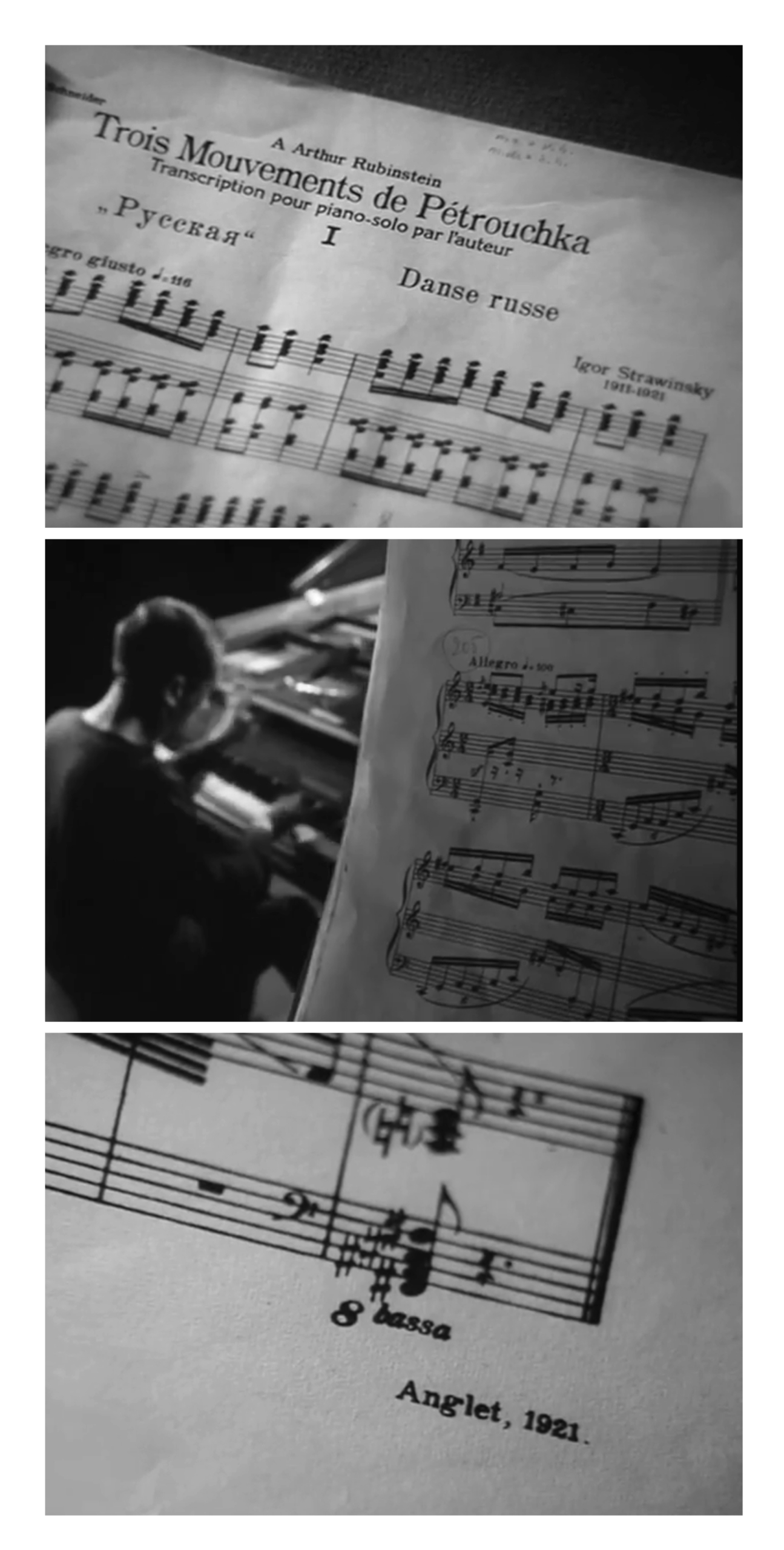
Figure 1a–c Video still from Falck (dir.) Three Movements from Petrushka (Stockhom, 1965). a) movement 1 “Danse russe,” 0 mins. 26 s.; b) movement 2 “Chez Pétrouchka,” 2 mins. 9 s.; c) movement 3 “La semaine grasse,” 7 mins. 43 s. © Ideale Audience International
While the film seems to underline the “choreographic” nature of the piano work as something inherent to it rather than imposed from without, the film constantly foregrounds the mediation of the work and the process of recording it. Periodically throughout the film, the camera closes in on single pages from the printed score—once in each of the three movements, to be precise (see figures 1a–c). The physical appearance of the score thus functions as a kind of framing device: the first page appears immediately before the performance starts, and the film ends with a close-up image of the final chord in the score. Movement 2 neither begins nor ends with an image of the score; rather, the score is shown open at the appropriate page in the middle of the movement, occupying half of the camera frame in the foreground with the pianist visible in the background. After a few seconds, the score is shakily withdrawn to the right-hand side of the screen.
The score seems to serve a double function in Falck’s film. On the one hand, it shows the score to be already a mediation of the work. As such it flaunts the challenge it poses: that of bringing to life, in the most virtuosic and inventive ways, the dead letter of the musical text. On the other, images of the score project its critical authority and Weissenberg’s sober—indeed technically flawless—fidelity to the musical text.
The references to technology and process seem equally designed to create the illusion of seamless, synchronic integration and “presence.” There is a wide shot in the third movement (“La semaine grasse,” starting at 3 mins. 40 s.) taken from a high vantage point that shows a microphone hanging from a stand and the piano in the background. While the image seems to draw attention to the technical process of recording and mediation, it also sustains the illusion that the audio had been recorded live in the studio and that the sound and image have an identical source in Weissenberg’s “performance” in the TV studio.
Weissenberg’s comment that the film was “choreographed for piano and [two] hands” is borne out above all in the close-up shots of his hands displaying the sheer physical demands of the work: the hands repeatedly spanning large intervals in a fraction of a second, sometimes crossing over one another, and especially the “diabolical cascades of arpeggi” (to recall Stravinsky’s own description of his germinal Konzertstück) preserved in the second movement of the transcription (“Chez Pétrouchka”).32 In these close-up shots, the movement of Weissenberg’s hands resembles that of dancing bodies. For instance, in the first movement (“Danse russe”), the left hand has a repeating pattern of staccato chords, and the close-up on Weissenberg’s hand causes it to resemble the same dance performed by the three puppets in Fokine’s original choreography. The cameras’ movements in relation to the piano and the performer elicits choreographic features that are in some sense shown to be always already in the work, hence the notion of “translatability.”
The case study of Falck’s film is a timely reminder of the various ways in which a multimedia work is in turn mediated by its own history, by its transformations and translations, and by its wider critical discourse. In blurring the distinction between a musico-theatrical work (such as ballet) and a “purely musical” performance or arrangement of the score, the film deconstructs the notion of the “purely musical” for Stravinsky’s Three Movements for piano as well as for his 1909-13 ballet scores in general. Nonetheless, the case of Petrushka helps to make this point more emphatically than almost any other musical work in the modernist canon: the figure of the suffering puppet is an all-too-prescient image of the diremptions of the performer-subject not only in modernism but in the contemporary landscapes of virtual and digital media—whether it be the process of “hand-synching” to a pre-existing track or that of bringing to life an inert score. Falck’s remarkable 1965 film of Weissenberg’s playing may serve as both a benchmark for the creative filming of musical performance today and a cautionary tale about the technical challenges of such a process and the implications of overcoming them.
-
A condensed version of this chapter was presented at the Annual Conference of the School of Performing Arts, University of Malta, 23-25 March 2022 (conference theme: “Mediating Performance: Technologies, Communities, Spaces”), and I am grateful to the participants in the session for their feedback. I also want to thank Carlo Cenciarelli and Michael Laus for helpful conversations on the topic.↩︎
-
Christoph Flamm, “Petrushka,” in The Cambridge Stravinsky Encyclopedia [hereafter TCSE] (Cambridge: Cambridge University Press, 2021), 322.↩︎
-
Terminologically, it may be more apt to speak of “exclusively musical” rather than “purely musical,” since the process is tantamount to the exclusion of the other arts, rather than the unveiling of a purely musical core. However, this chapter uses the more familiar term to allow it to intervene in an existing discourse.↩︎
-
John Deathridge, “Postmortem on Isolde,” in John Deathridge, Wagner Beyond Good and Evil (Berkeley, CA: University of California Press, 2008), 133-55. The chapter is a revised version of the previously published article: “Post-mortem on Isolde,” in New German Critique 69, Special Issue devoted to Richard Wagner, ed. David J. Levin (Autumn, 1996): 99-126. See also Catherine Clément, Opera, or the Undoing of Women, trans. Betsy Wing, foreword by Susan McClary (Minneapolis: University of Minnesota Press, 1988); originally published as L’Opéra, ou la défaite des femmes (Paris: B. Grasset, 1979).↩︎
-
Deathridge, “Postmortem on Isolde,” 141-42.↩︎
-
Ibid., 155.↩︎
-
Arved Ashby, Absolute Music, Mechanical Reproduction (Berkeley: University of California Press, 2010).↩︎
-
Based on two existing worklists or catalogues: Daniel Jaffé, “Appendix 1: Musical Works,” in TCSE, eds. Edward Campbell and Peter O’Hagan (Cambridge: Cambridge University Press, 2021), 506-35; and Helmut Kirchmeyer, “K012 Petrushka,” K Catalog: Annotated Catalog of Works and Work Editions of Igor Strawinsky till 1971, June 2020, accessed 5 February 2022, http://www.kcatalog.org/index.php/browse-chapters/kcatalog/179-k012-petrushka.↩︎
-
See Stephen Walsh, Stravinsky: A Creative Spring: Russia and France, 1882–1934 (London: Jonathan Cape, 2000), 164-5.↩︎
-
Igor Stravinsky, Chronicle of My Life, translated from the French (London: Victor Gollancz, 1936), 56.↩︎
-
Ibid.↩︎
-
Florent Fels, “Un entretien avec Igor Strawinsky à propos de l’enregistrement au phonographe de ‘Petrouchka’ [sic],” in Nouvelles littéraires, 8 December 1928: 11: “Dans mon idée primitive, je voyais un homme en frac, portant les cheveux longs: le musicien ou le poète de la tradition romantique. Il se plaçait au piano et roulait sur le clavier des objets hétéroclites tandis que l’orchestre éclatait en protestations véhéments, en coups de poing sonores.” Translation slightly modified from Richard Taruskin, Stravinsky and the Russian Traditions: A Biography of the Works Through Mavra, vol. 1 (Berkeley and Los Angeles, CA: University of California Press, 1996), 664.↩︎
-
Flamm, “Petrushka,” in TCSE, 319.↩︎
-
Jonathan Dunsby, Schoenberg: Pierrot lunaire, Cambridge Music Handbooks (Cambridge: Cambridge University Press, 1992), 2.↩︎
-
Stravinsky later noted that the offensive gesture is directed not at the Old Magician but at the audience. Igor Stravinsky and Robert Craft, Memories and Commentaries (London: Faber and Faber, 1960), 34.↩︎
-
Theodor W. Adorno, Philosophy of New Music, trans., ed., and with an introduction by Robert Hullot-Kentor (Minneapolis: University of Minnesota Press, 2006), 109. German original: “Pierrot und Petruschka, wie auch der Straussische Eulenspiegel, der ein paarmal so vernehmlich in Strawinskys Ballett anklingt, überleben der eigenen Untergang.” Theodor W. Adorno, Gesammelte Schriften: Philosophie der neuen Musik, vol. 12, ed. Rolf Tiedemann (Frankfurt am Main: Suhrkamp, 1975), 133. Stravinsky’s and Schoenberg’s mutual regard for each other’s work (for Pierrot lunaire and for Petrushka, respectively) is summarized by Stephen Walsh, chapter 4: “Petrushka meets Pierrot,” Igor Stravinsky: A Creative Spring, 186-200, especially 189-90.↩︎
-
Hullot-Kentor’s English translation (mis)reads “Pierrot und Petruschka” as the names of the works, not of the protagonists.↩︎
-
Caroline Disler, “Benjamin’s ‘Afterlife’: A Productive (?) Mistranslation in Memoriam Daniel Simeoni,” in Traduction, terminologie, rédaction [TTR] 24, no. 1 (2011): 183-221, 185. Otherwise I have relied on the English translation of Benjamin’s essay by Steven Rendall, “The Translator’s Task, Walter Benjamin,” in TTR 10, no. 2 (1997): 151-65. German original: “So wie die Äußerungen des Lebens innigst mit dem Lebendigen zusammenhängen, ohne ihm etwas zu bedeuten, geht die Übersetzung aus dem Original hervor. Zwar nicht aus seinem Leben so sehr denn aus seinem ‘Überleben’.” Walter Benjamin, “Die Aufgabe des Übersetzers,” in Walter Benjamin, Gesammelte Schriften, Vol. 4, ed. Rolf Tiedemann and Hermann Schweppenhäuser (Frankfurt am Main: Suhrkamp, 1985), 10.↩︎
-
“Vielmehr nur wenn allem demjenigen, wovon es Geschichte gibt und was nicht allein ihr Schauplatz ist, Leben zuerkannt wird, kommt dessen Begriff zu seinem Recht.” Benjamin, “Die Aufgabe des Übersetzers,” 11. Rendall, “The Translator’s Task,” in TTR 10, 153.↩︎
-
“Translation is a mode [eine Form];” Benjamin, “Die Aufgabe des Übersetzers,” 9; Rendall, “The Translator’s Task,” in TTR 10, 152.↩︎
-
Marshall McLuhan, Understanding Media: The Extensions of Man (Abingdon, Oxon: Routledge, 2001, first published 1964), 7ff.↩︎
-
Benjamin, “Die Aufgabe des Übersetzers,” 9ff.; Rendall, “The Translator’s Task,” in TTR 10, 152ff. See also Samuel Weber, Benjamin’s -abilities (Cambridge, MA: Harvard University Press, 2008).↩︎
-
Walter Benjamin, Gesammelte Schriften: Das Passagen-Werk, vol. 5, ed. Rolf Tiedemann (Frankfurt am Main: Suhrkamp, 1982); translated into English by Howard Eiland and Kevin McLaughlin, The Arcades Project (Cambridge, MA: Harvard University Press, 2002).↩︎
-
Stephanie Schroedter, Paris qui danse. Bewegungs- und Klangräume einer Großstadt der Moderne (Würzburg: Königshausen & Neumann, 2018).↩︎
-
Åke Falck (dir.), Three Movements from Petrushka, Alexis Weissenberg (piano), filmed for Sveriges Television (SVT), co-produced by MusicaGlotz (Stockholm, 1965); reissued on DVD: Classic ArchiveTM: Alexis Weissenberg (Ideale Audience International, 2008), item number 3078048, UPC number 899132000626. Falck would go on to direct Weissenberg as the soloist with the Berlin Philharmonic in a 1967 film of Tchaikovsky’s Piano Concerto No. 1 conducted by Herbert von Karajan.↩︎
-
In Weissenberg’s obituary in the UK newspaper The Times, the author made the astonishing claim that the film had been directed by Ingmar Bergman. Author anonymous, “Alexis Weissenberg” [obituary], The Times (24th January 2012), accessed 17 January 2022, https://www.thetimes.co.uk/article/alexis-weissenberg-nfdqgfzcvhc. Had Bergman been attached to the film in any way, it would surely have attracted more attention than it has to date.↩︎
-
“[…] chorégraphié pour un piano et des mains.” “Alexis Weissenberg talks about Petrushka,” bonus material in the 2008 DVD. Interviewer: Christian Labrande. Director: Philippe Truffault. Quotation from interview transcribed and translated by the present author.↩︎
-
See: Georg Wübbolt and Peter Gelb (dir.), Herbert von Karajan: Maestro for the Screen [DVD] (Berlin: Unitel Classica, C Major Entertainment GmbH, 2016); and Ramón Sanjuán Mínguez, “El Controvertido Legado Fílmico de Herbert von Karajan: Una Necesaria Revisión de los Desheredados,” in Revista de Musicología 41, no. 1 (January–June, 2018): 307-30.↩︎
-
Ben Winters, Music, Performance, and the Realities of Film: Shared Concert Experiences in Screen Fiction (New York: Routledge, 2014).↩︎
-
Anonymous description of compilation film directed by Pierre-Martin Juban, 2008, released on the online platform MediciTV, accessed 8 January 2022, https://www.medici.tv/en/concerts/alexis-weissenberg/, emphasis added.↩︎
-
I am grateful to Gerard Corvin for referring me to a copy of the film.↩︎
-
The bitonal scales and arpeggios between the two hands (including the so-called “Petrushka chord”) remain one of the technically easier passages of the entire piece for a pianist, even if to the untrained ear they sound the most impressive.↩︎